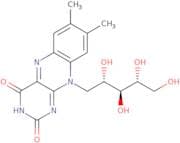
CAS 83-88-5
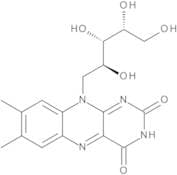
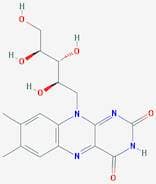
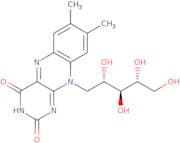
:Riboflavin
- 1-Deoxy-1-(3,4-dihydro-7,8-dimethyl-2,4-dioxobenzo[g]pteridin-10(2H)-yl)-<span class="text-smallcaps">D</span>-ribitol
- 1-Deoxy-1-(3,4-dihydro-7,8-dimethyl-2,4-dioxobenzo[g]pteridin-10(2H)-yl)-D-ribitol
- 1-deoxy-1-(7,8-dimethyl-2,4-dioxo-3,4-dihydrobenzo[g]pteridin-10(2H)-yl)-D-ribitol
- 1-deoxy-1-(7,8-dimethyl-2,4-dioxo-3,4-dihydrobenzo[g]pteridin-10(2H)-yl)pentitol
- 5-deoxy-5-(7,8-dimethyl-2,4-dioxo-3,4-dihydrobenzo[g]pteridin-10(2H)-yl)-D-ribitol
- 6,7-Dimethyl-9-<span class="text-smallcaps">D</span>-ribitylisoalloxazine
- 6,7-Dimethyl-9-D-ribitylisoalloxazine
- 6,7-Dimethyl-9-ribitylisoalloxazine
- 7,8-Dimethyl-10-(1,2,3,4,5-pentahydroxypentyl)benzo[g]pteridine-2,4-dione
- 7,8-Dimethyl-10-(D-ribo-2,3,4,5-tetrahydroxypentyl)isoalloxazine
- 7,8-Dimethyl-10-ribitylisoalloxazine
- <span class="text-smallcaps">D</span>-Ribitol, 1-deoxy-1-(3,4-dihydro-7,8-dimethyl-2,4-dioxobenzo[g]pteridin-10(2H)-yl)-
- Beflavin
- Beflavine
- Benzo[g]pteridine, riboflavin deriv.
- Benzo[g]pteridine-2,4(3H,10H)-dione, 7,8-dimethyl-10-(<span class="text-smallcaps">D</span>-ribo-2,3,4,5-tetrahydroxypentyl)-
- Benzo[g]pteridine-2,4(3H,10H)-dione, 7,8-dimethyl-10-(D-ribo-2,3,4,5-tetrahydroxypentyl)-
- D-Ribitol, 1-deoxy-1-(3,4-dihydro-7,8-dimethyl-2,4-dioxobenzo[g]pteridin-10(2H)-yl)-
- E 101
- E 101 (dye)
- Flavaxin
- Flavin BB
- Flaxain
- Food Yellow 15
- Hyre
- Lactobene
- Lactoflavin
- Lactoflavine
- Nci 0033298
- Nsc 33298
- Ribipca
- Ribocrisina
- Riboderm
- Riboflavin (1.07609)
- Riboflavin E101
- Riboflavin F
- Riboflavin FP
- Riboflavin, 6,8-dimethyl-, D-
- Riboflavina
- Riboflavine
- Ribosyn
- Ribotone
- Ribovel
- Ricrolin
- Russupteridine yellow III
- San Yellow B
- VB2
- Vitaflavine
- Vitamin B2
- Vitamin B<sub>2</sub>
- Vitamin B_2
- Vitamin G
- Vitasan B2
- Vitasan B<sub>2</sub>
- See more synonyms
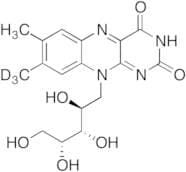
Riboflavine 8-Methyl-D3
CAS:Controlled ProductApplications Riboflavine 8-Methyl-d3 is the deuterated form of Riboflavin (R414995), which is a vitamin (enzyme cofactor) found in milk, eggs, malted barley, liver, kidney, heart, and leafy vegetables. Richest natural source is yeast. Minute amounts present in all plant and animal cells.
References Unna, K., et al.: J. Pharmacol. Exp. Ther., 76, 75 (1942); Rivlin, et al.: N. Engl. J. Med., 283, 463 (1970); Al-Shammary, F.J., et al.: Anal. Profiles Drug Subs., 19, 429 (1990);Formula:C17D3H17N4O6Color and Shape:NeatMolecular weight:379.382(-)-Riboflavin
CAS:Controlled ProductStability Hygroscopic
Applications (-)-Riboflavin is a nutritional factor found in milk, eggs, malted barley, liver, kidney, heart, leafy vegetables. Richest natural source is yeast. Minute amounts present in all plant and animal cells. Vitamin (enzyme cofactor).
References Unna, K., et al.: J. Pharmacol. Exp. Ther., 76, 75 (1942), Rivlin, et al.: N. Engl. J. Med., 283, 463 (1970), Al-Shammary, F.J., et al.: Anal. Profiles Drug Subs., 19, 429 (1990),Formula:C17H20N4O6Color and Shape:NeatMolecular weight:376.36Riboflavin
CAS:Riboflavin is a water-soluble vitamin, which is derived primarily from dietary sources such as milk, eggs, nuts, and green vegetables. As a precursor to coenzymes flavin mononucleotide (FMN) and flavin adenine dinucleotide (FAD), riboflavin plays a crucial role within the cellular metabolic pathways. These coenzymes are essential for redox reactions occurring in mitochondrial energy metabolism, particularly within the electron transport chain.Formula:C17H20N4O6Purity:Min. 98 Area-%Color and Shape:Yellow PowderMolecular weight:376.36 g/molRiboflavin pure, 98%
CAS:Formula:C17H20N4O6Purity:min. 98%Color and Shape:Orange yellow, Crystalline powder, Clear, OrangeMolecular weight:376.37Riboflavin for cell culture, 98%, Endotoxin (BET) 0.05EU/mg
CAS:Formula:C17H20N4O6Purity:min. 98%Color and Shape:Orange yellow, Crystalline powder, Clear, OrangeMolecular weight:376.37Riboflavin
CAS:Formula:C17H20N4O6Purity:98%Color and Shape:Solid, Orange crystalline powderMolecular weight:376.369Riboflavin galactoside
CAS:Riboflavin galactoside (RGG) is a fluorescent compound that can be used as a marker for cell proliferation. It is particularly useful in immunohistochemical techniques, which are used to detect the presence of antigens in tissue. RGG is sensitive to light, and thus it can be detected using techniques such as disintegrations per minute (DPM). RGG has been shown to be an efficient cellular target for amplifying RNA in cells. This compound also interacts with molecules that are involved in cellular growth and development, including antibodies.Formula:C23H30N4O11Purity:Min. 95%Molecular weight:538.5 g/molRiboflavin
CAS:Riboflavin is a water-soluble vitamin, which is primarily sourced from dietary intake, including milk, eggs, lean meats, green vegetables, and nuts. It acts as a precursor to the coenzymes flavin mononucleotide (FMN) and flavin adenine dinucleotide (FAD), essential for redox reactions in cellular metabolism. These coenzymes play a critical role in the electron transport chain and oxidative phosphorylation, facilitating the conversion of nutrients into energy via ATP production.Formula:C17H20N4O6Purity:Min. 98 Area-%Molecular weight:376.36 g/molRef: 3D-W-104132
-Unit-kgkgTo inquire1kgTo inquire5kgTo inquire10kgTo inquire25kgTo inquire2500gTo inquire