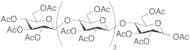
CAS 83058-38-2
:D-Glucopyranose, O-2,3,4,6-tetra-O-acetyl-β-D-glucopyranosyl-(1→4)-O-2,3,6-tri-O-acetyl-β-D-glucopyranosyl-(1→4)-O-2,3,6-tri-O-acetyl-β-D-glucopyranosyl-(1→4)-O-2,3,6-tri-O-acetyl-β-D-glucopyranosyl-(1→4)-, tetraacetate
Description:
D-Glucopyranose, O-2,3,4,6-tetra-O-acetyl-β-D-glucopyranosyl-(1→4)-O-2,3,6-tri-O-acetyl-β-D-glucopyranosyl-(1→4)-O-2,3,6-tri-O-acetyl-β-D-glucopyranosyl-(1→4)-O-2,3,6-tri-O-acetyl-β-D-glucopyranosyl-(1→4)-, tetraacetate (CAS 83058-38-2) is a complex carbohydrate derivative characterized by multiple acetyl groups attached to its glucopyranose units. This compound is a glycoside, specifically a disaccharide formed from β-D-glucopyranose units linked through (1→4) glycosidic bonds. The presence of acetyl groups enhances its solubility in organic solvents and can influence its reactivity and stability. The acetylation also affects the compound's biological activity, potentially modulating interactions with enzymes and receptors. This substance is typically used in synthetic organic chemistry and carbohydrate chemistry for various applications, including the synthesis of more complex oligosaccharides and polysaccharides. Its structural complexity makes it a valuable compound for studying carbohydrate interactions and properties in biochemical research.
Formula:C64H86O43
InChI:InChI=1S/C64H86O43/c1-23(65)82-18-40-45(87-28(6)70)50(88-29(7)71)56(94-35(13)77)61(100-40)105-47-42(20-84-25(3)67)102-63(58(96-37(15)79)52(47)90-31(9)73)107-49-44(22-86-27(5)69)103-64(59(97-38(16)80)54(49)92-33(11)75)106-48-43(21-85-26(4)68)101-62(57(95-36(14)78)53(48)91-32(10)74)104-46-41(19-83-24(2)66)99-60(98-39(17)81)55(93-34(12)76)51(46)89-30(8)72/h40-64H,18-22H2,1-17H3/t40-,41-,42-,43-,44-,45-,46-,47-,48-,49-,50+,51+,52+,53+,54+,55-,56-,57-,58-,59-,60?,61+,62+,63+,64+/m1/s1
InChI key:InChIKey=UTUMCHTVRXZKAE-VTHYYUHUSA-N
SMILES:O([C@H]1[C@H](OC(C)=O)[C@@H](OC(C)=O)[C@H](O[C@H]2[C@H](OC(C)=O)[C@@H](OC(C)=O)[C@H](O[C@H]3[C@H](OC(C)=O)[C@@H](OC(C)=O)C(OC(C)=O)O[C@@H]3COC(C)=O)O[C@@H]2COC(C)=O)O[C@@H]1COC(C)=O)[C@H]4[C@H](OC(C)=O)[C@@H](OC(C)=O)[C@H](O[C@H]5[C@H](OC(C)=O)[C@@H](OC(C)=O)[C@H](OC(C)=O)[C@@H](COC(C)=O)O5)[C@@H](COC(C)=O)O4
Synonyms:- Cellopentaose heptadecaacetate
- D-Glucopyranose, O-2,3,4,6-tetra-O-acetyl-β-D-glucopyranosyl-(1→4)-O-2,3,6-tri-O-acetyl-β-D-glucopyranosyl-(1→4)-O-2,3,6-tri-O-acetyl-β-D-glucopyranosyl-(1→4)-O-2,3,6-tri-O-acetyl-β-D-glucopyranosyl-(1→4)-, tetraacetate
Sort by
Purity (%)
0
100
|
0
|
50
|
90
|
95
|
100
Found 3 products.
D-Cellopentose Heptadecaacetate
CAS:Controlled ProductStability Store at +5°C
Applications D-Cellopentose Heptadecaacetate (cas# 83058-38-2) is a compound useful in organic synthesis.Formula:C64H86O43Color and Shape:NeatMolecular weight:1543.34D-Cellopentose heptadecaacetate
CAS:D-Cellopentose heptadecaacetate is a fluorinated, monosaccharide that is synthesized from the sugar cellobiose. It is an oligosaccharide and a complex carbohydrate with one of its glycosidic bonds modified by methylation. D-Cellopentose heptadecaacetate has been shown to be effective in inhibiting glycosylation reactions and can be used as a sugar substitute or for custom synthesis. This product has been shown to have high purity and is available at CAS No. 83058-38-2.Formula:C64H86O43Purity:Min. 95%Color and Shape:White to off-white solid.Molecular weight:1,543.34 g/mol