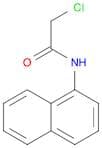
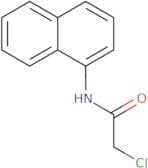
CAS 832-89-3
:2-chloro-N-(naphthalen-1-yl)acetamide
Description:
2-Chloro-N-(naphthalen-1-yl)acetamide, with the CAS number 832-89-3, is an organic compound characterized by its amide functional group and the presence of a chloro substituent. This compound features a naphthalene ring, which contributes to its aromatic properties and potential biological activity. The chloro group enhances its reactivity and can influence its solubility and interaction with other molecules. Typically, compounds like this may exhibit moderate to high lipophilicity due to the naphthalene moiety, which can affect their pharmacokinetics if considered for medicinal applications. The presence of the acetamide group suggests potential for hydrogen bonding, which can influence its physical properties such as melting point and solubility in polar solvents. Additionally, this compound may be of interest in various fields, including pharmaceuticals and agrochemicals, due to its structural features that could impart specific biological activities. Safety and handling precautions should be observed, as with many chlorinated compounds, due to potential toxicity and environmental impact.
Formula:C12H10ClNO
InChI:InChI=1/C12H10ClNO/c13-8-12(15)14-11-7-3-5-9-4-1-2-6-10(9)11/h1-7H,8H2,(H,14,15)
SMILES:c1ccc2c(c1)cccc2N=C(CCl)O
Sort by
Purity (%)
0
100
|
0
|
50
|
90
|
95
|
100
Found 3 products.
2-Chloro-N-naphthalen-1-yl-acetamide
CAS:Formula:C12H10ClNOPurity:95.0%Color and Shape:SolidMolecular weight:219.672-Chloro-N-1-naphthylacetamide
CAS:2-Chloro-N-1-naphthylacetamide is a synthetic organic compound that belongs to the class of sulfur compounds. It is used in the synthesis of other compounds and has been shown to be a potent inhibitor of hydroxylapatite and sulfate hydrolysis. The reaction mechanism for this compound’s inhibition of sulfate hydrolysis is not known, but it may be due to its ability to act as an electron donor or acceptor. 2-Chloro-N-1-naphthylacetamide also has carcinogenic properties, with some studies suggesting that it can cause liver cancer in rodents.Formula:C12H10ClNOPurity:Min. 95%Molecular weight:219.67 g/mol