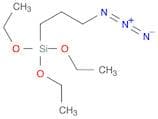
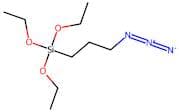
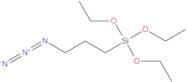
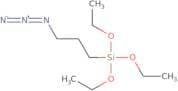
CAS 83315-69-9
:3-(azidopropyl)triethoxysilane
- 3-(Azidopropyl)triethoxysilane
- Einecs 280-374-1
- Silane,(3-azidopropyl)triethoxy-
3-(Azidopropyl)triethoxysilane
CAS:Formula:C9H21N3O3SiPurity:97%Color and Shape:LiquidMolecular weight:247.36683-AZIDOPROPYLTRIETHOXYSILANE
CAS:Azide Functional Trialkoxy Silane
Silane coupling agents have the ability to form a durable bond between organic and inorganic materials to generate desired heterogeneous environments or to incorporate the bulk properties of different phases into a uniform composite structure. The general formula has two classes of functionality. The hydrolyzable group forms stable condensation products with siliceous surfaces and other oxides such as those of aluminum, zirconium, tin, titanium, and nickel. The organofunctional group alters the wetting or adhesion characteristics of the substrate, utilizes the substrate to catalyze chemical transformations at the heterogeneous interface, orders the interfacial region, or modifies its partition characteristics, and significantly effects the covalent bond between organic and inorganic materials.
3-Azidopropyltriethoxysilane; Trimethoxysilylpropylazide
Used with click chemistry to introduce and immobilize discrete complexes onto the SBA-15 surfaceUsed in the preparation of poly-L-lysine bound to silica nanoparticlesCoupling agent for surface modificationAVOID CONTACT WITH METALSFormula:C9H21N3O3SiPurity:97%Color and Shape:Straw Amber LiquidMolecular weight:247.373-(Azidopropyl)triethoxysilane
CAS:Formula:C9H21N3O3SiPurity:97%Color and Shape:LiquidMolecular weight:247.373-(Azidopropyl)triethoxysilane
CAS:3-(Azidopropyl)triethoxysilane is a chemical compound that is used as an immobilization agent for metal ions. It is typically synthesized by reacting triethoxysilane with azide and can be used to immobilize metal ions on the surface of various materials, such as glass, silicon, or other substrates. 3-(Azidopropyl)triethoxysilane has been shown to have anticancer activity in vitro against MCF-7 cells. This compound induces cancer cell death by binding to the cell membrane and disrupting its lipid bilayer. 3-(Azidopropyl)triethoxysilane also has a diameter of 6.3 nm, which allows it to cross the membrane easily.
Formula:C9H21N3O3SiPurity:Min. 95 Area-%Color and Shape:Clear LiquidMolecular weight:247.37 g/molRef: 3D-IDA31569
Discontinued product