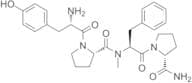
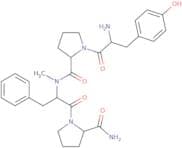
CAS 83397-56-2
:L-tyrosyl-L-prolyl-N-methyl-L-phenylalanyl-D-prolinamide
Description:
L-tyrosyl-L-prolyl-N-methyl-L-phenylalanyl-D-prolinamide, with the CAS number 83397-56-2, is a synthetic peptide that exhibits characteristics typical of peptide compounds. It is composed of several amino acids, including tyrosine, proline, phenylalanine, and proline, which contribute to its structural and functional properties. This compound is likely to be soluble in polar solvents, such as water or dimethyl sulfoxide (DMSO), due to the presence of polar side chains. The N-methylation of phenylalanine may enhance its stability and bioavailability. Peptides like this one often exhibit biological activity, potentially interacting with specific receptors or enzymes in biological systems. The presence of both L- and D-amino acids suggests that it may have unique conformational properties, which can influence its biological activity and interactions. Additionally, the specific arrangement of amino acids can affect its pharmacokinetics and pharmacodynamics, making it a subject of interest in medicinal chemistry and drug development.
Formula:C29H37N5O5
InChI:InChI=1/C29H37N5O5/c1-32(25(18-19-7-3-2-4-8-19)29(39)33-15-5-9-23(33)26(31)36)28(38)24-10-6-16-34(24)27(37)22(30)17-20-11-13-21(35)14-12-20/h2-4,7-8,11-14,22-25,35H,5-6,9-10,15-18,30H2,1H3,(H2,31,36)/t22-,23+,24-,25-/m0/s1
Synonyms:- D-prolinamide, L-tyrosyl-L-prolyl-N-methyl-L-phenylalanyl-
- Pl017
Sort by
Purity (%)
0
100
|
0
|
50
|
90
|
95
|
100
Found 2 products.
PL-017
CAS:μ opioid receptor agonist; IC50: 5.5 nM (μ), >10,000 nM (δ). Induces reversible analgesia, catalepsy, hyperthermia in rats.Formula:C29H37N5O5Purity:98%Color and Shape:SolidMolecular weight:535.64PL 017
CAS:PL 017 is a synthetic delta-opioid that binds to kappa opioid receptors and inhibits voltage-dependent calcium channels. It has been shown to be effective in preventing restenosis by inhibiting platelet aggregation, which is the process of blood cells sticking together and forming clots. PL 017 also has an antinociceptive effect, which may be due to its membrane hyperpolarization effect and inhibition of adrenergic receptors. This drug can be used as a diagnostic tool for detecting receptor binding sites in cell cultures. PL 017 has been shown to inhibit the binding of naloxone, which is an antagonist of opioid receptors, to the mu-opioid receptor by 50%. The molecular modeling technique was used to show that PL 017 binds with high affinity at the delta-opioid receptor site.Formula:C29H37N5O5Purity:Min. 95%Molecular weight:535.6 g/mol