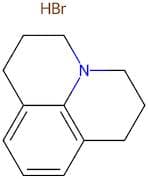
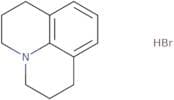
CAS 83646-41-7
:julolidine hydrobromide
Description:
Julolidine hydrobromide is a chemical compound that is a salt formed from julolidine, a bicyclic amine, and hydrobromic acid. It typically appears as a white to off-white crystalline solid. Julolidine itself is known for its aromatic properties and is used in various organic synthesis applications. The hydrobromide form enhances its solubility in polar solvents, making it useful in laboratory settings. This compound is characterized by its basicity due to the presence of the nitrogen atom in the julolidine structure, which can accept protons. Julolidine hydrobromide may exhibit biological activity, and its derivatives are often explored in medicinal chemistry. Safety data indicates that, like many amines and their salts, it should be handled with care, as it may cause irritation upon contact with skin or mucous membranes. Proper storage in a cool, dry place, away from incompatible substances, is recommended to maintain its stability and integrity.
Formula:C12H16BrN
InChI:InChI=1/C12H15N.BrH/c1-4-10-6-2-8-13-9-3-7-11(5-1)12(10)13;/h1,4-5H,2-3,6-9H2;1H
Sort by
Purity (%)
0
100
|
0
|
50
|
90
|
95
|
100
Found 3 products.
Julolidine hydrobromide
CAS:Formula:C12H16BrNPurity:99%Color and Shape:SolidMolecular weight:254.1661Julolidine hydrobromide
CAS:Julolidine hydrobromide is a photophysical analog that has been shown to bind to the acceptor site of the azobenzene, producing fluorescence. The fluorescence intensity is proportional to the concentration of julolidine hydrobromide in solution. The photophysics are due to a shift in the absorption spectrum and dipole moment of julolidine hydrobromide from its ground state to an excited state. This change in energy level and conformation causes a bathochromic shift in the emission spectrum. A conformation-dependent optical transition between two different conformations of julolidine hydrobromide also occurs, which can be described as a transfer process. Julolidine hydrobromide has been found to have an effective dose at 1mg/kg when used as a treatment for cancerous cells.Formula:C12H15N·HBrPurity:Min. 95%Molecular weight:254.17 g/mol