

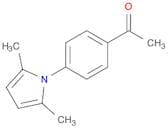
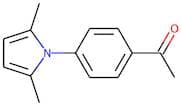
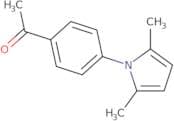
![1-[4-(2,5-Dimethyl-1H-pyrrol-1-yl)phenyl]ethanone](/_next/image/?url=https%3A%2Fstatic.cymitquimica.com%2Fcas-image%2Fthumb-webp%2F370252-1-4-25-dimethyl-1h-pyrrol-1-yl-phenyl-ethanone.webp&w=3840&q=75)
CAS 83935-45-9
:1-[4-(2,5-Dimethyl-1H-pyrrol-1-yl)phenyl]ethanone
Description:
1-[4-(2,5-Dimethyl-1H-pyrrol-1-yl)phenyl]ethanone, with the CAS number 83935-45-9, is an organic compound characterized by its ketone functional group and a complex aromatic structure. This compound features a phenyl ring substituted with a pyrrole moiety, which contributes to its unique chemical properties. The presence of the 2,5-dimethyl substituents on the pyrrole ring enhances its steric and electronic characteristics, potentially influencing its reactivity and interactions with other molecules. Typically, compounds of this nature may exhibit interesting biological activities, making them of interest in medicinal chemistry and material science. The molecular structure suggests potential applications in organic synthesis, where it could serve as an intermediate or a building block for more complex molecules. Additionally, its solubility and stability in various solvents can vary, which is crucial for its practical applications. Overall, this compound exemplifies the diverse chemistry associated with substituted aromatic and heterocyclic systems.
Formula:C14H15NO
InChI:InChI=1S/C14H15NO/c1-10-4-5-11(2)15(10)14-8-6-13(7-9-14)12(3)16/h4-9H,1-3H3
InChI key:InChIKey=QYTWQHUEXYLNLA-UHFFFAOYSA-N
SMILES:CC=1N(C2=CC=C(C(C)=O)C=C2)C(C)=CC1
Synonyms:- 1-(4-Acetylphenyl)-2,5-dimethyl-1H-pyrrole
- 1-[4-(2,5-Dimethyl-1H-pyrrol-1-yl)phenyl]ethan-1-one
- 1-[4-(2,5-Dimethyl-pyrrol-1-yl)-phenyl]-ethanone
- 1-[4-(2,5-Dimethylpyrrol-1-yl)phenyl]ethanone
- 1-[4-(2,5-dimethyl-1H-pyrrol-1-yl)phenyl]ethanone
- 4-(2,5-Dimethylpyrrol-1-yl)acetophenone
- Ethanone, 1-[4-(2,5-dimethyl-1H-pyrrol-1-yl)phenyl]-
- 1-(4-Acetylphenyl)-2,5-dimethylpyrrole
Sort by
Purity (%)
0
100
|
0
|
50
|
90
|
95
|
100
Found 4 products.
1-(4-(2,5-Dimethyl-1H-pyrrol-1-yl)phenyl)ethanone
CAS:Formula:C14H15NOPurity:98%Color and Shape:SolidMolecular weight:213.2750N-(4-Acetylphenyl)-2,5-dimethylpyrrole
CAS:N-(4-Acetylphenyl)-2,5-dimethylpyrrole is a salicylic acid organocatalyst that has been shown to catalyze the conversion of carboxylic acids (e.g., acetic acid) to esters (e.g., ethyl acetate). This reaction is a result of the electron transfer from the PYR moiety to the carbon atom in the carboxylic acid. The use of microwaves and irradiation as catalysts increases the rate of this reaction by increasing the frequency of collisions between reactants. This catalyst can also be used for other reactions, such as aliphatic substitution, reductive amination, or nitration reactions. N-(4-Acetylphenyl)-2,5-dimethylpyrrole has been shown to produce high yields and selectivity in these reactions when compared to other organocatalysts.
Formula:C14H15NOPurity:Min. 95%Color and Shape:PowderMolecular weight:213.27 g/mol



![1-[4-(2,5-Dimethyl-1h-pyrrol-1-yl)phenyl]ethanone](/_next/image/?url=https%3A%2Fstatic.cymitquimica.com%2Fproducts%2F10%2Fthumb%2FF612917.jpg&w=3840&q=75)
