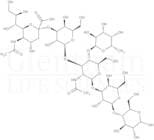
CAS 84061-53-0
:O-(N-Acetyl-α-neuraminosyl)-(2→3)-O-β-D-galactopyranosyl-(1→3)-O-[6-deoxy-α-L-galactopyranosyl-(1→4)]-O-2-(acetylamino)-2-deoxy-β-D-glucopyranosyl-(1→3)-O-β-D-galactopyranosyl-(1→4)-D-glucose
Description:
The chemical substance known as "O-(N-Acetyl-α-neuraminosyl)-(2→3)-O-β-D-galactopyranosyl-(1→3)-O-[6-deoxy-α-L-galactopyranosyl-(1→4)]-O-2-(acetylamino)-2-deoxy-β-D-glucopyranosyl-(1→3)-O-β-D-galactopyranosyl-(1→4)-D-glucose," with the CAS number 84061-53-0, is a complex glycosylated compound characterized by multiple sugar moieties linked through specific glycosidic bonds. This structure includes neuraminic acid, which contributes to its biological significance, particularly in cell recognition and signaling processes. The presence of acetylamino groups suggests potential interactions with biological systems, enhancing its solubility and stability. The compound's intricate arrangement of galactose and glucose units indicates its role in polysaccharide formation and may influence its reactivity and interaction with other biomolecules. Such glycosylated compounds are often involved in various biological functions, including immune response and pathogen recognition, making them of interest in biochemistry and medicinal chemistry. Overall, this substance exemplifies the complexity and diversity of glycan structures in biological systems.
Formula:C43H72N2O33
InChI:InChI=1S/C43H72N2O33/c1-11-23(58)28(63)29(64)39(69-11)74-33-20(10-51)72-38(76-36-26(61)18(8-49)70-40(30(36)65)73-32(17(57)7-48)24(59)15(55)5-46)22(45-13(3)53)35(33)75-41-31(66)37(27(62)19(9-50)71-41)78-43(42(67)68)4-14(54)21(44-12(2)52)34(77-43)25(60)16(56)6-47/h5,11,14-41,47-51,54-66H,4,6-10H2,1-3H3,(H,44,52)(H,45,53)(H,67,68)/t11-,14-,15-,16+,17+,18+,19+,20+,21+,22+,23+,24+,25+,26-,27-,28+,29-,30+,31+,32+,33+,34+,35+,36-,37-,38-,39-,40-,41-,43-/m0/s1
InChI key:InChIKey=DBXMZPZIFJCVQO-HTLVECFOSA-N
SMILES:O([C@H]1[C@H](O[C@H]2[C@@H](O)[C@H](O)[C@H](O)[C@H](C)O2)[C@@H](CO)O[C@@H](O[C@@H]3[C@@H](O)[C@H](O[C@@H]([C@@H]([C@H](C=O)O)O)[C@@H](CO)O)O[C@H](CO)[C@@H]3O)[C@@H]1NC(C)=O)[C@H]4[C@H](O)[C@@H](O[C@@]5(C(O)=O)O[C@@]([C@@H]([C@@H](CO)O)O)([C@H](NC(C)=O)[C@@H](O)C5)[H])[C@@H](O)[C@@H](CO)O4
Synonyms:- <span class="text-smallcaps">D</smallcap>-Glucose, O-(N-acetyl-α-neuraminosyl)-(2→3)-O-β-<smallcap>D</smallcap>-galactopyranosyl-(1→3)-O-[6-deoxy-α-<smallcap>L</smallcap>-galactopyranosyl-(1→4)]-O-2-(acetylamino)-2-deoxy-β-<smallcap>D</smallcap>-glucopyranosyl-(1→3)-O-β-<smallcap>D</span>-galactopyranosyl-(1→4)-
- F-LSTa
- FLST-a
- Fucosyl-LST a
- Fucosyl-lacto-N-sialylpentaose a
- O-(N-Acetyl-α-neuraminosyl)-(2→3)-O-β-<span class="text-smallcaps">D</smallcap>-galactopyranosyl-(1→3)-O-[6-deoxy-α-<smallcap>L</smallcap>-galactopyranosyl-(1→4)]-O-2-(acetylamino)-2-deoxy-β-<smallcap>D</smallcap>-glucopyranosyl-(1→3)-O-β-<smallcap>D</smallcap>-galactopyranosyl-(1→4)-<smallcap>D</span>-glucose
- Sialyl Le<sup>a</sup> penta
- Sialyl monofucosyllacto-N-tetraose
- SialylLea penta
- O-(N-Acetyl-α-neuraminosyl)-(2→3)-O-β-D-galactopyranosyl-(1→3)-O-[6-deoxy-α-L-galactopyranosyl-(1→4)]-O-2-(acetylamino)-2-deoxy-β-D-glucopyranosyl-(1→3)-O-β-D-galactopyranosyl-(1→4)-D-glucose
- D-Glucose, O-(N-acetyl-α-neuraminosyl)-(2→3)-O-β-D-galactopyranosyl-(1→3)-O-[6-deoxy-α-L-galactopyranosyl-(1→4)]-O-2-(acetylamino)-2-deoxy-β-D-glucopyranosyl-(1→3)-O-β-D-galactopyranosyl-(1→4)-
- Sialyl Lea penta
- MONOSIALYL, MONOFUCOSYLLACTO-N-TETRAOSE
- Sialylfucosyllacto-N-tetraose
- SIALYL-LEA-HEXASACCHARIDE (19-9)
- Sialyl(mono), monofucosyllacto-N-tetraose
- See more synonyms
Sort by
Purity (%)
0
100
|
0
|
50
|
90
|
95
|
100
Found 2 products.
Sialylfucosyllacto-N-tetraose
CAS:Sialylfucosyllacto-N-tetraose is a human milk oligosaccharide (HMO) and is present in lower concentrations than 2â²-fucosyllactose. Sialylfucosyllacto-N-tetraose contains both nitrogen and sialic acid in its chemical structure. It has been demostrated that sialylfucosyllacto-N-tetraose in the HMO pool acts as a prebiotic, protects against infections and inflammation, modulates the immune system, supports brain development, and reduces the risk of necrotizing enterocolitis (WiciÅski, 2020).
Formula:C43H72N2O33Purity:Min. 95 Area-%Color and Shape:PowderMolecular weight:1,145.03 g/mol