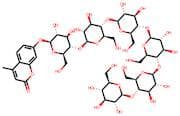
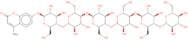
CAS 84325-21-3
:7-[(O-β-D-Glucopyranosyl-(1→4)-O-β-D-glucopyranosyl-(1→4)-O-β-D-glucopyranosyl-(1→4)-O-β-D-glucopyranosyl-(1→4)-O-β-D-glucopyranosyl-(1→4)-β-D-glucopyranosyl)oxy]-4-methyl-2H-1-benzopyran-2-one
Description:
The chemical substance known as "7-[(O-β-D-Glucopyranosyl-(1→4)-O-β-D-glucopyranosyl-(1→4)-O-β-D-glucopyranosyl-(1→4)-O-β-D-glucopyranosyl-(1→4)-O-β-D-glucopyranosyl-(1→4)-β-D-glucopyranosyl)oxy]-4-methyl-2H-1-benzopyran-2-one," with the CAS number 84325-21-3, is a complex glycosylated flavonoid. This compound features a benzopyran backbone, which is characteristic of flavonoids, and is extensively glycosylated with multiple β-D-glucopyranosyl units linked through (1→4) glycosidic bonds. The presence of these sugar moieties enhances its solubility in water and may influence its biological activity, including antioxidant properties and potential health benefits. The structure suggests that it may exhibit various pharmacological effects, as many flavonoids are known for their anti-inflammatory, antiviral, and anticancer activities. Additionally, the specific arrangement of the glycosyl groups can affect the compound's stability, reactivity, and interaction with biological systems. Overall, this substance represents a significant example of the diversity found in natural products derived from plant sources.
Formula:C46H68O33
InChI:InChI=1S/C46H68O33/c1-12-4-22(53)68-15-5-13(2-3-14(12)15)67-41-31(62)25(56)36(17(7-48)70-41)76-43-33(64)27(58)38(19(9-50)72-43)78-45-35(66)29(60)40(21(11-52)74-45)79-46-34(65)28(59)39(20(10-51)73-46)77-44-32(63)26(57)37(18(8-49)71-44)75-42-30(61)24(55)23(54)16(6-47)69-42/h2-5,16-21,23-52,54-66H,6-11H2,1H3/t16-,17-,18-,19-,20-,21-,23-,24+,25-,26-,27-,28-,29-,30-,31-,32-,33-,34-,35-,36-,37-,38-,39-,40-,41-,42+,43+,44+,45+,46+/m1/s1
InChI key:InChIKey=UTBJMLYZMZEJEQ-PFIONZJYSA-N
SMILES:O([C@@H]1[C@@H](CO)O[C@@H](O[C@@H]2[C@@H](CO)O[C@@H](O[C@@H]3[C@@H](CO)O[C@@H](OC=4C=C5C(=CC4)C(C)=CC(=O)O5)[C@H](O)[C@H]3O)[C@H](O)[C@H]2O)[C@H](O)[C@H]1O)[C@@H]6O[C@H](CO)[C@@H](O[C@@H]7O[C@H](CO)[C@@H](O[C@@H]8O[C@H](CO)[C@@H](O)[C@H](O)[C@H]8O)[C@H](O)[C@H]7O)[C@H](O)[C@H]6O
Synonyms:- 7-[(O-β-D-Glucopyranosyl-(1→4)-O-β-D-glucopyranosyl-(1→4)-O-β-D-glucopyranosyl-(1→4)-O-β-D-glucopyranosyl-(1→4)-O-β-D-glucopyranosyl-(1→4)-β-D-glucopyranosyl)oxy]-4-methyl-2H-1-benzopyran-2-one
- 2H-1-Benzopyran-2-one, 7-[(O-β-D-glucopyranosyl-(1→4)-O-β-D-glucopyranosyl-(1→4)-O-β-D-glucopyranosyl-(1→4)-O-β-D-glucopyranosyl-(1→4)-O-β-D-glucopyranosyl-(1→4)-β-D-glucopyranosyl)oxy]-4-methyl-
Sort by
Purity (%)
0
100
|
0
|
50
|
90
|
95
|
100
Found 3 products.
4-Methylumbelliferyl β-D-cellohexaoside
CAS:4-Methylumbelliferyl β-D-cellohexaosidePurity:>95%Molecular weight:1,149.01g/mol4-Methylumbelliferyl β-D-cellohexaoside
CAS:4-Methylumbelliferyl beta-D-cellohexaoside is a fluorogenic substrate for cellulase. After enzymatic cleaveage, free 4-methylumbelliferone (also known as hymecromone) is released, exhibiting blue fluorescence upon excitation with UV light. The strongest fluorescence of 4-methylumbelliferone requires deprotonation of the hydroxyl group (thus requires alkaline pH), with a maximal fluorescence intensity obtained with excitation at 350 to 370 nm and emission at 440 to 470 nm. The use of 4-methylumbelliferyl beta-D-cellohexaosideas a substrate for measuring the cellulase activity is used for detecting bacterial infection and gut microbiome analysis.Formula:C46H68O33Purity:Min. 95%Color and Shape:PowderMolecular weight:1,149.01 g/mol