CAS 84539-35-5
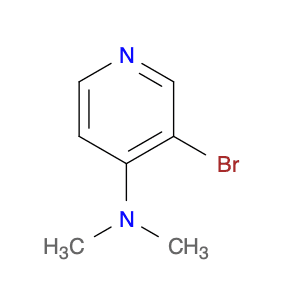
:3-bromo-N,N-dimethylpyridin-4-amine
Description:
3-Bromo-N,N-dimethylpyridin-4-amine is an organic compound characterized by its pyridine ring, which is a six-membered aromatic heterocycle containing one nitrogen atom. The presence of a bromine atom at the 3-position and two dimethylamino groups at the 4-position contributes to its unique chemical properties. This compound typically appears as a solid or liquid, depending on its purity and environmental conditions. It is soluble in polar organic solvents, reflecting the influence of the nitrogen-containing functional groups. The bromine substituent can participate in various chemical reactions, such as nucleophilic substitutions, making it a useful intermediate in organic synthesis. Additionally, the dimethylamino groups enhance its basicity and can influence its reactivity and interaction with biological systems. As with many nitrogen-containing compounds, it may exhibit biological activity, which could be of interest in pharmaceutical research. Safety data should be consulted for handling, as halogenated amines can pose health risks.
Formula:C7H9BrN2
InChI:InChI=1/C7H9BrN2/c1-10(2)7-3-4-9-5-6(7)8/h3-5H,1-2H3
SMILES:CN(C)c1ccncc1Br
Synonyms:- 3-Bromo-4-(N,N-Dimethyl)Aminopyridine
Sort by
Purity (%)
0
100
|
0
|
50
|
90
|
95
|
100
Found 4 products.
3-BROMO-N,N-DIMETHYLPYRIDIN-4-AMINE
CAS:Formula:C7H9BrN2Purity:97%Color and Shape:LiquidMolecular weight:201.06383-Bromo-N,N-dimethylpyridin-4-amine
CAS:3-Bromo-N,N-dimethylpyridin-4-aminePurity:97%Molecular weight:201.06g/mol3-Bromo-N,N-dimethylpyridin-4-amine
CAS:Formula:C7H9BrN2Purity:97%Color and Shape:LiquidMolecular weight:201.0673-Bromo-N,N-dimethylpyridin-4-amine
CAS:3-Bromo-N,N-dimethylpyridin-4-amine is a chiral primary amine that can be used in cross-coupling reactions. It can be used as a nucleophilic catalyst to promote the formation of carbon-carbon bonds between two organic molecules. The reaction is catalyzed by chloride ion, which reacts with the sulfoxide group and generates an alkoxide ion. The alkoxide ion then reacts with the alcohol compound, forming a new carbon-carbon bond. This reaction is most efficient when using a primary alkylamine such as 3-bromo-N,N-dimethylpyridin-4-amine.Formula:C7H9BrN2Purity:Min. 95%Molecular weight:201.06 g/mol