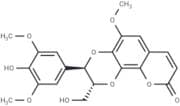
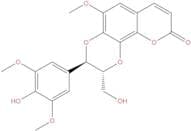
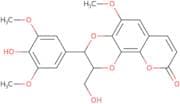
CAS 84575-10-0
:9H-Pyrano[2,3-f]-1,4-benzodioxin-9-one,2,3- dihydro-3-(4-hydroxy-3,5-dimethoxyphenyl)- 2-(hydroxymethyl)-5-methoxy-,(2R,3R)-rel-
Description:
9H-Pyrano[2,3-f]-1,4-benzodioxin-9-one, 2,3-dihydro-3-(4-hydroxy-3,5-dimethoxyphenyl)-2-(hydroxymethyl)-5-methoxy-, (2R,3R)-rel- is a complex organic compound characterized by its unique bicyclic structure that incorporates both a pyran and a benzodioxin moiety. This compound features multiple functional groups, including methoxy and hydroxymethyl substituents, which contribute to its potential biological activity. The presence of hydroxyl groups suggests possible interactions with biological targets, making it of interest in medicinal chemistry. Its stereochemistry, indicated by the (2R,3R)- designation, implies specific spatial arrangements that can influence its reactivity and interactions. The compound's CAS number, 84575-10-0, allows for precise identification in chemical databases. Overall, this substance may exhibit properties relevant to pharmacology, including antioxidant or anti-inflammatory activities, although specific biological effects would require further investigation through experimental studies.
- Cleomiscosin C
Sort by
Purity (%)
0
100
|
0
|
50
|
90
|
95
|
100
Found 3 products.
Cleomiscosin C
CAS:Cleomiscosin C, an antioxidant, inhibits apoB-100 oxidation (IC50: 23.6µM Cu2+, 3.9µM HOCl), may prevent LDL oxidation; A, B, and C protect the liver.Formula:C21H20O9Purity:98%Color and Shape:SolidMolecular weight:416.38Cleomiscosin C
CAS:Cleomiscosin C is a natural coumarin compound, which is sourced from plants of the genus Cleome, commonly found in tropical and subtropical regions. It functions primarily through its ability to modulate multiple biological pathways, including anti-inflammatory and antioxidant activities. This modulatory action is attributed to its chemical structure, enabling it to interact with cellular receptors and enzymes involved in oxidative stress response and inflammation.Formula:C21H20O9Purity:Min. 95%Molecular weight:416.4 g/mol