CAS 84611-22-3
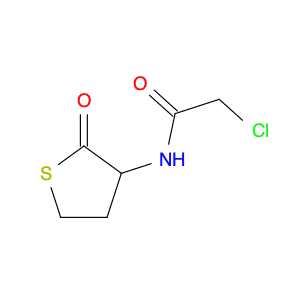
:N-Chloroacetyl-DL-Homocysteine Thiolactone
Description:
N-Chloroacetyl-DL-Homocysteine Thiolactone is a chemical compound characterized by its unique structure, which includes a thiolactone ring and a chloroacetyl group. This compound is a derivative of homocysteine, an amino acid that plays a crucial role in various metabolic processes. The presence of the thiolactone ring contributes to its reactivity, making it a potential intermediate in organic synthesis and a useful building block in medicinal chemistry. The chloroacetyl group enhances its electrophilic properties, allowing it to participate in nucleophilic substitution reactions. N-Chloroacetyl-DL-Homocysteine Thiolactone is typically handled with care due to its potential reactivity and the presence of chlorine, which can pose health risks. It is important to note that compounds like this may have specific applications in research, particularly in the study of biochemical pathways involving homocysteine and its derivatives. As with any chemical substance, proper safety protocols should be followed when handling and using this compound in laboratory settings.
Sort by
Purity (%)
0
100
|
0
|
50
|
90
|
95
|
100
Found 7 products.
2-Chloro-N-(2-oxothiolan-3-yl)acetamide
CAS:Formula:C6H8ClNO2SPurity:95%Color and Shape:SolidMolecular weight:193.65122-Chloro-N-(2-oxothiolan-3-yl)acetamide
CAS:2-Chloro-N-(2-oxothiolan-3-yl)acetamideFormula:C6H8ClNO2SPurity:95%Color and Shape: white solidMolecular weight:193.65g/molN-Chloroacetyl DL-Homocysteine Thiolactone
CAS:Impurity Erdosteine Impurity RV 142
Applications An intermediate in the synthesis of Erdosteine (E596050).Erdosteine is a mucolytic agent used for the treatment of chronic obstructive bronchitis.
References Gobetti, M., et al.: Farmaco, Edizione Scientifica, 41, 69 (1986),Formula:C6H8ClNO2SColor and Shape:NeatMolecular weight:193.652-Chloro-N-(2-oxotetrahydro-3-thienyl)acetamide
CAS:2-Chloro-N-(2-oxotetrahydro-3-thienyl)acetamide is a chemical compound that is used as an intermediate in the synthesis of other organic compounds. The impurities are minimized by using organic solvents such as acetone, pyridine, and tetrahydrofuran. The product can be precipitated by adding sodium carbonate or potassium carbonate to the solution, or it can be crystallized from a mixture of methanol and water. 2-Chloro-N-(2-oxotetrahydro-3-thienyl)acetamide is also soluble in ethers such as erdosteine and acetonitrile, which can be used to remove the last traces of water.Formula:C6H8ClNO2SPurity:Min. 95%Molecular weight:193.65 g/mol