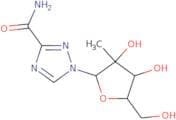
CAS 847651-91-6
:1H-1,2,4-Triazole-3-carboxamide,1-(2-C-methyl-beta-D-ribofuranosyl)-
Description:
1H-1,2,4-Triazole-3-carboxamide, 1-(2-C-methyl-beta-D-ribofuranosyl)- is a chemical compound characterized by its triazole ring structure, which is a five-membered heterocyclic compound containing three nitrogen atoms. This compound features a carboxamide functional group, contributing to its potential as a bioactive molecule. The presence of the 2-C-methyl-beta-D-ribofuranosyl moiety indicates that it is a nucleoside analog, which may influence its biological activity, particularly in relation to nucleic acid metabolism. The compound is likely to exhibit solubility in polar solvents due to the presence of the carboxamide group, and it may participate in hydrogen bonding interactions. Its structural features suggest potential applications in medicinal chemistry, particularly in antiviral or anticancer research, as many triazole derivatives have shown promising pharmacological properties. However, specific biological activities, stability, and reactivity would require further investigation through experimental studies.
Sort by
Purity (%)
0
100
|
0
|
50
|
90
|
95
|
100
Found 2 products.
1-(2-C-Methyl-b-D-ribofuranosyl)-1H-1,2,4-triazole-3-carboxamide
CAS:1-(2-C-Methyl-b-D-ribofuranosyl)-1H-1,2,4-triazole-3-carboxamide is a modified nucleoside that is used as an antiviral and anticancer agent. It is a diphosphate derivative of 1-(2'-deoxyribofuranosyl)-1H-1,2,4-triazole. The compound has been shown to have antiviral activity against herpes simplex virus (HSV) type I and HSV type II in vitro. It also inhibits the growth of human tumor cells in culture by interfering with DNA synthesis. The compound has been reported to be active against leukemia cells in vivo but not against normal cells. It has a high level of toxicity at high doses.
Purity:Min. 95%