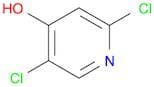
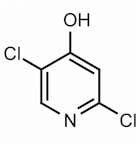
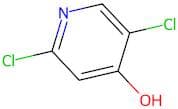
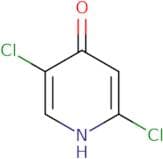
CAS 847664-65-7
:2,5-Dichloro-4-pyridinol
Description:
2,5-Dichloro-4-pyridinol is an organic compound characterized by its pyridine ring substituted with two chlorine atoms and a hydroxyl group. It typically appears as a solid or crystalline substance and is known for its potential applications in various fields, including agriculture and pharmaceuticals. The presence of chlorine atoms enhances its reactivity and may contribute to its biological activity. This compound is soluble in polar solvents, which can influence its behavior in different chemical environments. Its molecular structure allows for hydrogen bonding due to the hydroxyl group, which can affect its solubility and interaction with other molecules. Additionally, 2,5-Dichloro-4-pyridinol may exhibit antimicrobial properties, making it of interest in the development of pesticides or therapeutic agents. As with many chemical substances, safety precautions should be observed when handling it, as it may pose health risks if ingested or inhaled. Always refer to material safety data sheets (MSDS) for detailed safety and handling information.
Formula:C5H3Cl2NO
InChI:InChI=1S/C5H3Cl2NO/c6-3-2-8-5(7)1-4(3)9/h1-2H,(H,8,9)
InChI key:InChIKey=RJKYZTVQNJPAGX-UHFFFAOYSA-N
SMILES:OC=1C(Cl)=CN=C(Cl)C1
Synonyms:- 2,5-Dichloro-1H-pyridin-4-one
- 2,5-Dichloro-4-hydroxypyridine
- 2,5-Dichloro-4-pyridinol
- 4-Pyridinol, 2,5-dichloro-
Sort by
Purity (%)
0
100
|
0
|
50
|
90
|
95
|
100
Found 4 products.
2,5-dichloropyridin-4-ol
CAS:Formula:C5H3Cl2NOPurity:98%Color and Shape:SolidMolecular weight:163.9894Ref: IN-DA003308
50gTo inquire100gTo inquire100mg43.00€250mg57.00€1g109.00€5g204.00€10g297.00€25g559.00€2,5-Dichloro-4-hydroxypyridine
CAS:2,5-Dichloro-4-hydroxypyridineFormula:C5H3Cl2NOPurity:≥95%Color and Shape: yellow powderMolecular weight:163.99g/mol2,5-Dichloro-4-hydroxypyridine
CAS:2,5-Dichloro-4-hydroxypyridine is a strong oxidizing agent that can be used for the efficient synthesis of esters and peroxy esters. It can also be used to produce hydrogen peroxide from hydroxylamine and 2,5-dichloro-4-hydroxypyridine. The hydroxylation of alcohols with 2,5-dichloro-4-hydroxypyridine produces the corresponding n-oxides or peroxides in high yield. This reaction is regioselective, meaning it will only occur at one position on the molecule.
Formula:C5H3Cl2NOPurity:Min. 95%Molecular weight:163.99 g/mol