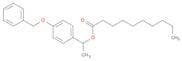
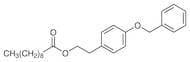
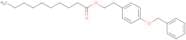
![Decanoic acid, 2-[4-(phenylmethoxy)phenyl]ethyl ester](/_next/image/?url=https%3A%2Fstatic.cymitquimica.com%2Fcas-image%2Fthumb-webp%2F117149-decanoic-acid-2-4-phenylmethoxy-phenyl-ethyl-ester.webp&w=3840&q=75)
CAS 848484-93-5
:Decanoic acid, 2-[4-(phenylmethoxy)phenyl]ethyl ester
Description:
Decanoic acid, 2-[4-(phenylmethoxy)phenyl]ethyl ester, also known by its CAS number 848484-93-5, is an organic compound characterized by its ester functional group, which is formed from the reaction of decanoic acid and a phenylmethoxy-substituted ethyl alcohol. This compound typically exhibits a hydrophobic nature due to its long carbon chain, which contributes to its solubility in organic solvents while being less soluble in water. The presence of the phenylmethoxy group enhances its potential for various applications, including use as a surfactant or in the synthesis of more complex organic molecules. Its molecular structure suggests potential biological activity, making it of interest in pharmaceutical and chemical research. Additionally, the compound may exhibit properties such as stability under standard conditions, moderate volatility, and potential reactivity with nucleophiles due to the ester bond. Safety data should be consulted for handling and storage, as with any chemical substance, to ensure proper precautions are taken.
Formula:C25H34O3
Synonyms:- Dpmpe
Sort by
Purity (%)
0
100
|
0
|
50
|
90
|
95
|
100
Found 5 products.
4-(Benzyloxy)phenethyl decanoate
CAS:Formula:C25H34O3Purity:98%Color and Shape:SolidMolecular weight:382.53574-(Benzyloxy)Phenethyl Decanoate
CAS:4-(Benzyloxy)Phenethyl DecanoatePurity:98%Molecular weight:382.542g/mol4-(Benzyloxy)phenethyl Decanoate
CAS:Formula:C25H34O3Purity:>98.0%(GC)Color and Shape:White to Light yellow powder to crystalMolecular weight:382.542-(4-Benzyloxyphenyl)ethyl decanoate
CAS:The flower of this plant is an endemism of the Acanthaceae family, which are also known as the Acanthus family. The flowers are typically white and have 10-20 petals. They grow in clusters on a stem that can be up to 3 feet tall and have a sweet smell. The flowers are pollinated by bees and other insects such as flies. This plant is endemic to the island of Madagascar and is found only in a few isolated places, making it rare.
Formula:C25H34O3Purity:Min. 95%Color and Shape:White PowderMolecular weight:382.54 g/mol