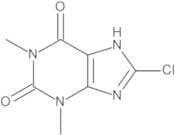
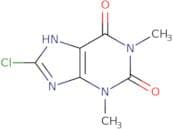
CAS 85-18-7
:8-Chlorotheophylline
Description:
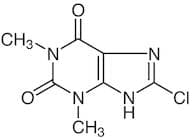
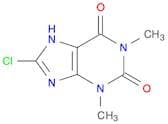
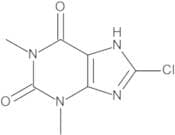
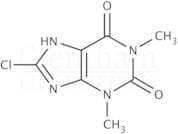
8-Chlorotheophylline is a chemical compound that belongs to the class of methylxanthines, which are derivatives of xanthine. It is structurally related to theobromine and theophylline, featuring a chlorine atom at the 8-position of theophylline. This compound is typically a white to off-white crystalline powder and is soluble in water, reflecting its polar nature. 8-Chlorotheophylline exhibits pharmacological properties, including mild stimulant effects on the central nervous system, and has been studied for its potential use in various therapeutic applications, such as respiratory conditions and as a diuretic. Its mechanism of action is primarily attributed to the inhibition of phosphodiesterase enzymes, leading to increased levels of cyclic AMP in cells. Additionally, it may have effects on smooth muscle relaxation, particularly in the bronchial passages. Safety and toxicity profiles should be considered, as with any pharmacologically active compound, and it is important to handle it with care in laboratory settings.
Formula:C7H7ClN4O2
InChI:InChI=1S/C7H7ClN4O2/c1-11-4-3(9-6(8)10-4)5(13)12(2)7(11)14/h1-2H3,(H,9,10)
InChI key:InChIKey=RYIGNEOBDRVTHA-UHFFFAOYSA-N
SMILES:O=C1C2=C(N(C)C(=O)N1C)N=C(Cl)N2
Synonyms:- 1,3-Dimethyl-8-chloroxanthine
- 1H-Purine-2,6-dione, 8-chloro-3,7-dihydro-1,3-dimethyl-
- 1H-Purine-2,6-dione, 8-chloro-3,9-dihydro-1,3-dimethyl-
- 8-Chloro Theophylline
- 8-Chloro-1,3-dimethyl-2,6(1H,3H)-purinedione
- 8-Chloro-1,3-dimethyl-2,6-purinedione
- 8-Chloro-1,3-dimethylxanthine
- 8-Chloro-3,9-dihydro-1,3-dimethyl-1H-purine-2,6-dione
- 8-chloro-1,3-dimethyl-3,7-dihydro-1H-purine-2,6-dione
- NSC 6113
- Theophylline, 8-chloro-
- See more synonyms
Sort by
Purity (%)
0
100
|
0
|
50
|
90
|
95
|
100
Found 12 products.
8-Chlorotheophylline
CAS:Formula:C7H7ClN4O2Purity:>98.0%(T)(HPLC)Color and Shape:White to Almost white powder to crystalMolecular weight:214.618-Chlorotheophylline
CAS:Theophylline and aminophylline (excluding fenetylline) and their derivatives, salts thereof, not elsewhere specified or includedFormula:C7H7ClN4O2Color and Shape:White Off-White Crystalline PowderMolecular weight:214.025758-Chloro-1,3-dimethyl-1H-purine-2,6(3H,7H)-dione
CAS:Formula:C7H7ClN4O2Purity:95%Color and Shape:SolidMolecular weight:214.60918-Chlorotheophylline
CAS:Controlled ProductFormula:C7H7ClN4O2Color and Shape:NeatMolecular weight:214.618-Chlorotheophylline
CAS:Formula:C7H7ClN4O2Purity:(HPLC) ≥ 99.0%Color and Shape:White to off-white solidMolecular weight:214.618-Chlorotheophylline
CAS:Applications A stimulant drug. It can be used as a binding agent to form stable salts of pharmaceutical drugs.
References Lyles, M. et al.: J. Med. Chem. 44, 4650 (2001).Formula:C7H7ClN4O2Color and Shape:WhiteMolecular weight:214.618-Chloro-1,3-dimethyl-1H-purine-2,6(3H,7H)-dione
CAS:Formula:C7H7ClN4O2Purity:≥98%Color and Shape:SolidMolecular weight:214.618-Chlorotheophylline
CAS:Controlled Product8-Chlorotheophylline is a chemical compound used in pharmaceutical preparations as an antispasmodic and bronchodilator. It is a derivative of theophylline and has been shown to bind to receptors in the brain, lungs, heart, and smooth muscles. 8-Chlorotheophylline has been shown to have broad-spectrum antimicrobial activity against both Gram-positive and Gram-negative bacteria. The compound is water soluble at physiological pH levels and does not require a buffer for stability. This agent can be prepared by using a sample preparation procedure that includes adding sodium carbonate followed by caffeine to extract the sample from a biological matrix such as tissue or blood. 8-Chlorotheophylline can be analyzed by chromatography with UV detection (254 nm) or fluorescence detection (365 nm).Formula:C7H7ClN4O2Purity:Min. 95%Color and Shape:White PowderMolecular weight:214.61 g/molPamabrom Related Compound A (8-Chlorotheophylline) (DISCONTINUED)
CAS:Theophylline and aminophylline (excluding fenetylline) and their derivatives, salts thereof, not elsewhere specified or includedFormula:C7H7ClN4O2Color and Shape:PowderMolecular weight:214.02575