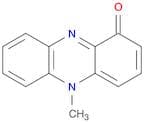
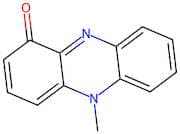
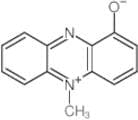
CAS 85-66-5
:Pyocyanin
Description:
Pyocyanin is a blue-green phenazine compound produced primarily by the bacterium Pseudomonas aeruginosa. It is known for its distinctive color and is a key virulence factor in infections caused by this pathogen. Pyocyanin exhibits redox activity, allowing it to participate in electron transfer processes, which can lead to oxidative stress in host cells. This compound is soluble in organic solvents and has a relatively low solubility in water, which influences its biological activity and interactions. Pyocyanin has been studied for its potential roles in biofilm formation, antibiotic resistance, and its effects on immune responses. Additionally, it has been investigated for its potential applications in biotechnology and medicine, particularly due to its antimicrobial properties. However, its production is often associated with pathogenicity, making it a significant factor in chronic infections, especially in individuals with compromised immune systems or underlying lung conditions. Overall, pyocyanin is a notable compound in microbiology and biochemistry, reflecting the complex interplay between microbial metabolites and host responses.
Formula:C13H10N2O
InChI:InChI=1S/C13H10N2O/c1-15-10-6-3-2-5-9(10)14-13-11(15)7-4-8-12(13)16/h2-8H,1H3
InChI key:InChIKey=YNCMLFHHXWETLD-UHFFFAOYSA-N
SMILES:CN1C=2C(=NC=3C1=CC=CC3)C(=O)C=CC2
Synonyms:- 1(5H)-phenazinone, 5-methyl-
- 5-Methyl-1(5H)-phenazinone
- 85-66-5
- Pyocyanin
- Pyocyanine
- Sanasin
- Sanazin
Sort by
Purity (%)
0
100
|
0
|
50
|
90
|
95
|
100
Found 3 products.
Pyocyanin (Technical Grade)
CAS:Controlled ProductApplications Pyocyanin is an antibiotic accelerator of neutrophil apoptosis.
Formula:C13H10N2OColor and Shape:NeatMolecular weight:210.23