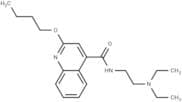
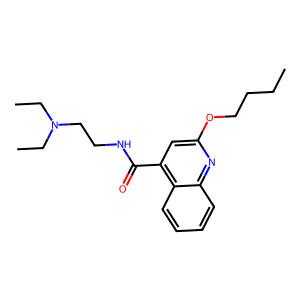
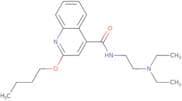
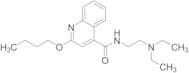
CAS 85-79-0
:Dibucaine
Description:
Dibucaine, also known as butamben, is a local anesthetic belonging to the amino amide class. It is primarily used for its analgesic properties in medical applications, particularly in procedures requiring localized pain relief. The chemical formula for dibucaine is C18H28N2O, and it features a relatively high lipophilicity, which enhances its potency and duration of action compared to other local anesthetics. Dibucaine acts by blocking sodium channels in nerve membranes, thereby inhibiting the propagation of nerve impulses. It is typically administered via injection or topical application. The substance is known for its potential side effects, including allergic reactions and systemic toxicity, particularly in cases of overdose or improper administration. Additionally, dibucaine is often used in combination with other agents to enhance its efficacy. Due to its potency, careful dosing and monitoring are essential during its use in clinical settings. As with all anesthetics, it is crucial to consider patient-specific factors and contraindications before administration.
Formula:C20H29N3O2
InChI:InChI=1S/C20H29N3O2/c1-4-7-14-25-19-15-17(16-10-8-9-11-18(16)22-19)20(24)21-12-13-23(5-2)6-3/h8-11,15H,4-7,12-14H2,1-3H3,(H,21,24)
InChI key:InChIKey=PUFQVTATUTYEAL-UHFFFAOYSA-N
SMILES:C(NCCN(CC)CC)(=O)C=1C2=C(N=C(OCCCC)C1)C=CC=C2
Synonyms:- 2-Butoxy-N-[2-(diethylamino)ethyl]-4-quinolinecarboxamide
- 2-Butoxy-N-[2-(diethylamino)ethyl]cinchoninamide
- 2-Butoxy-N-[2-(diethylamino)ethyl]quinoline-4-carboxamide
- 2-butoxy-N-(2-diethylaminoethyl)quinoline-4-carboxamide
- 4-Quinolinecarboxamide, 2-butoxy-N-[2-(diethylamino)ethyl]-
- Cinchocain
- Cinchocaine
- Cinchocaine Base
- Cinchoninamide, 2-butoxy-N-[2-(diethylamino)ethyl]-
- Cincocainio
- Dermacaine
- Dibucaine (base and/or unspecified salts)
- Dibucaine Free Base Crystalline
- Dibucaine Solution
- Dibucaine Usp
- Dibucaine base
- N-[2-(Diethylamino)ethyl]-2-butoxycinchoninamide
- Nsc 159055
- Nupercainal
- Nupercaine
- Percamine
- See more synonyms
Sort by
Purity (%)
0
100
|
0
|
50
|
90
|
95
|
100
Found 7 products.
Dibucaine
CAS:Dibucaine (Cinchocaine), a local anesthetic of the amide type, is now usually used for surface anesthesia.Formula:C20H29N3O2Purity:99.698% - 99.88%Color and Shape:Colorless Or Almost Colorless Powder SolidMolecular weight:343.46Cinchocaine (Dibucaine)
CAS:Formula:C20H29N3O2Color and Shape:White To Off-White SolidMolecular weight:343.47Cinchocaine - USP
CAS:Cinchocaine is a local anesthetic, which is used to relieve pain. Cinchocaine is a member of the amide class of local anesthetics. It has been shown to have neuronal death and mitochondrial membrane potential-inhibiting properties. Cinchocaine also binds to the hydrophobic region of voltage-sensitive potassium channels (Kv1.2), resulting in their closure and preventing action potentials from propagating through the neuron. The optimum concentration for cinchocaine is 0.1% (w/v). The optimal pH range for cinchocaine is 7.0 - 8.0, with a phase transition temperature of 78°C and a melting point of 117°C. Cinchocaine has been shown to be effective in animal models at concentrations as low as 10 µg/mL, with significant therapeutic effects observed at concentrations greater than 50 µg/mLFormula:C20H29N3O2Purity:Min. 95%Color and Shape:White PowderMolecular weight:343.46 g/molCinchocaine
CAS:Controlled ProductApplications Cinchocaine - (CAS# 85-79-0) is a useful research chemical compound.
Formula:C20H29N3O2Color and Shape:White To Off-WhiteMolecular weight:343.46