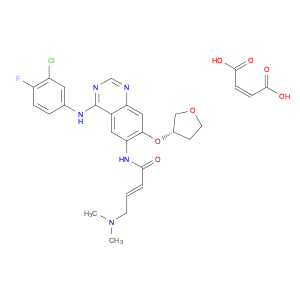
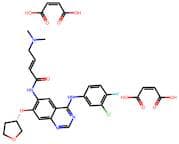
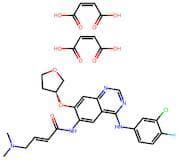
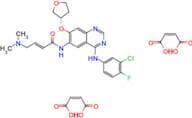
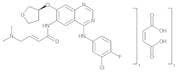
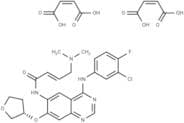
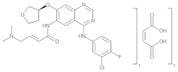
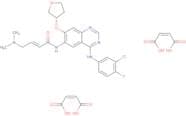
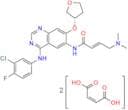
CAS 850140-73-7
:Afatinib dimaleate
- 2-Butenamide, N-[4-[(3-chloro-4-fluorophenyl)amino]-7-[[(3S)-tetrahydro-3-furanyl]oxy]-6-quinazolinyl]-4-(dimethylamino)-, (2E)-, (2Z)-2-butenedioate (1:2)
- BIBW2992 DiMaleate
- Bibw 2992Ma2
- Bibw2992-Ma2
- BIBW 2992 dimaleate
- Afatinib dimaleate
- Afatinib (diMaleate), BIBW2992
- Afatinib dimaleate BIBW 2992MA2
- Afatinib double Maleate
- N-[4-[(3-chloro-4-fluorophenyl)amino]-7-[[(3S)-tetrahydro-3-furanyl]oxy]-6-quinazolinyl]-4-(dimethylamino)-(2E)-2-butenamide,(2Z)-2-butenedioate (1:2)
- Afatinib (BIBW2992) Dimaleate
- (S,E)-N-(4-((3-Chloro-4-fluorophenyl)amino)-7-((tetrahydrofuran-3-yl)oxy)quinazolin-6-yl)-4-(d
- (2E)-N-(4-[(3-chloro-4-fluorophenyl)aMino]-7-{[(3S)
- Afatinib dimaleate, >=99%
- See more synonyms
afatinib dimaleate
CAS:Formula:C32H33ClFN5O11Purity:98%Color and Shape:SolidMolecular weight:718.0827Afatinib Dimaleate
CAS:Controlled ProductFormula:C24H25ClFN5O3C4H4O4Color and Shape:NeatMolecular weight:718.08Afatinib Dimaleate
CAS:Afatinib Dimaleate (BIBW 2992MA2) is an orally bioavailable anilino-quinazoline derivative and inhibitor of the EGFR family, with antineoplastic activity.Formula:C32H33ClFN5O11Purity:98.11% - 99.87%Color and Shape:SolidMolecular weight:718.08Afatinib Dimaleate
CAS:Controlled ProductApplications Afatinib Dimaleate is a salt of Afatinib {BIBW 2992) (B377000), an aminocrotonylamino-substituted quinazoline derivative used for treating cancer and diseases of the respiratory tract, lungs, gastrointestinal tract, bile duct, and gallbladder. An anilino-quinazoline that irreversibly inhibits EGFR and HER2 kinase activity.
References D, Li. et al.: Oncogene., 27, 4702 (2008); Wang, X. et al.: Cancer Res., 74, 4431 (2014);Formula:C24H25ClFN5O3·2C4H4O4Color and Shape:NeatMolecular weight:718.08Afatinib dimaleate
CAS:Irreversible blocker of three members of the ErbB family (ErbB1, ErbB2/HER2, and ErbB4) with IC50 in nanomolar range. The compound binds covalently to cysteine 797 residue in HER2 and blocks downstream cellular signalling, inhibits cellular growth and promotes apoptosis. Afatinib has been used for the treatment of tyrosine kinase inhibitor-resistant tumours with mutations in ErbB genes, especially for deletions in exon 19 and single nucleotide substitutions in exon 21. It has been used for treatment of non-small cell lung cancer (NSCLC), breast cancer, pancreatic cancer, colorectal cancer, etc.
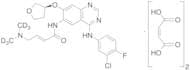
Formula:C24H25ClFN5O3·C8H8O8Purity:Min. 95%Color and Shape:SolidMolecular weight:718.08 g/molAfatinib-d6 Dimaleate
CAS:Controlled ProductApplications Afatinib-d6 Dimaleate is deuterium labelled Afatinib Dimaleate, which is a salt of Afatinib (BIBW 2992) (B377000). BIBW 2992 is an aminocrotonylamino-substituted quinazoline derivative used for treating cancer and diseases of the respiratory tract, lungs, gastrointestinal tract, bile duct, and gallbladder. An anilino-quinazoline that irreversibly inhibits EGFR and HER2 kinase activity.
References D, Li. et al.: Oncogene., 27, 4702 (2008); Wang, X. et al.: Cancer Res., 74, 4431 (2014)Formula:C24D6H19ClFN5O3·C4H4O4Color and Shape:NeatMolecular weight:608.048