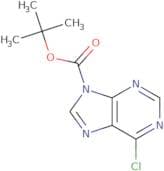
CAS 851165-38-3
:9-Boc-6-chloro-9H-purine
Description:
9-Boc-6-chloro-9H-purine is a chemical compound that belongs to the purine family, characterized by its bicyclic structure composed of a fused imidazole and pyrimidine ring. The "Boc" (tert-butyloxycarbonyl) group is a protective group commonly used in organic synthesis, particularly in the protection of amines. The presence of the chloro substituent at the 6-position of the purine ring introduces a halogen, which can influence the compound's reactivity and biological activity. This compound is often utilized in medicinal chemistry and research due to its potential as a building block for nucleoside analogs or other biologically active molecules. Its solubility, stability, and reactivity can vary depending on the solvent and conditions used in synthesis or application. As with many purine derivatives, it may exhibit interesting interactions with biological targets, making it a subject of interest in drug development and biochemical studies. Safety precautions should be observed when handling this compound, as with all chemical substances.
Formula:C10H11ClN4O2
Synonyms:- 9H-Purine-9-carboxylic acid, 6-chloro-, 1,1-dimethylethyl ester
- 9-Boc-6-chloro-9H-purine
Sort by
Purity (%)
0
100
|
0
|
50
|
90
|
95
|
100
Found 1 products.
tert-Butyl 6-chloro-9H-purine-9-carboxylate
CAS:<p>Tert-Butyl 6-chloro-9H-purine-9-carboxylate is an intermediate for the synthesis of nucleosides, which are important for DNA and RNA. It is used in the synthesis of purines. The reaction to produce tert-butyl 6-chloro-9H-purine-9-carboxylate starts with trifluoroacetic acid reacting with a protected form of 9H purine to give a trifluoroacetate ester. The ester is then hydrolyzed to give the desired product. This process produces high yields of tert butyl 6 chloro 9H purine 9 carboxylate and can be used to synthesize nucleobases, including adenine, guanine, cytosine, thymine, uracil or hypoxanthine.</p>Formula:C10H11ClN4O2Purity:Min. 95%Molecular weight:254.67 g/mol