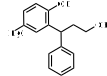
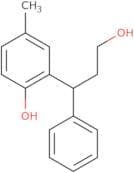
CAS 851789-43-0
:2-(3-Hydroxy-1-phenylpropyl)-4-methylphenol
Description:
2-(3-Hydroxy-1-phenylpropyl)-4-methylphenol, identified by its CAS number 851789-43-0, is a chemical compound that belongs to the class of phenolic compounds. It features a hydroxyl group (-OH) attached to a phenylpropyl chain, which contributes to its potential biological activity. The presence of the methyl group on the aromatic ring enhances its lipophilicity, potentially influencing its solubility and interaction with biological membranes. This compound may exhibit antioxidant properties due to the phenolic structure, which is known for its ability to scavenge free radicals. Additionally, the specific arrangement of functional groups can affect its pharmacokinetic and pharmacodynamic profiles, making it of interest in medicinal chemistry. Its applications may extend to various fields, including pharmaceuticals and cosmetics, where phenolic compounds are often utilized for their preservative and stabilizing effects. However, detailed studies on its toxicity, efficacy, and specific applications would be necessary to fully understand its characteristics and potential uses.
Formula:C16H18O2
InChI:InChI=1/C16H18O2/c1-12-7-8-16(18)15(11-12)14(9-10-17)13-5-3-2-4-6-13/h2-8,11,14,17-18H,9-10H2,1H3
SMILES:Cc1ccc(c(c1)C(CCO)c1ccccc1)O
Synonyms:- 3-(2-Hydroxy-5-methylphenyl)-3-phenylpropanol
Sort by
Purity (%)
0
100
|
0
|
50
|
90
|
95
|
100
Found 6 products.
Tolterodine Propanol Analog (2-(3-Hydroxy-1-phenylpropyl)-4-methylphenol)
CAS:Phenol-alcoholsFormula:C16H18O2Color and Shape:White Off-White Crystalline PowderMolecular weight:242.13068Tolterodine Impurity 10
CAS:Formula:C16H18O2Color and Shape:White To Off-White SolidMolecular weight:242.322-Hydroxy-5-methyl-gamma-phenylbenzenepropanol
CAS:2-Hydroxy-5-methylphenylbenzenepropanol is an aliphatic phenol that is used as a treatment for benzene poisoning. It is also used as a precursor to other compounds, such as the chlorides and alkylates of 2-hydroxy-5-methylphenylbenzenepropanol. This compound can be synthesized by reacting ethyl benzoylacetate with diisopropylamine in the presence of oxygen and chlorine gas. It is often immobilized using nutrients, l-tartaric acid, or cinnamic acid.Formula:C16H18O2Purity:Min. 95%Molecular weight:242.31 g/mol