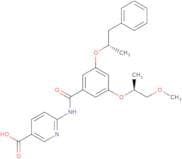
CAS 851884-87-2
:GKA-50
- GKA-50; GKA 50
- GKA 50
- GKA-50
- OCBMECSFDVUYQN-ROUUACIJSA-N
- 6-[[3-[(1S)-2-Methoxy-1-Methylethoxy]-5-[(1S)-1-Methyl-2-phenylethoxy]benzoyl]aMino]-3-pyridinecarboxylic Acid
- GKA50
6-[[3-[(1S)-2-Methoxy-1-methylethoxy]-5-[(1S)-1-methyl-2-phenylethoxy]benzoyl]amino]-3-pyridinecarboxylic Acid
CAS:Controlled ProductApplications 6-[[3-[(1S)-2-Methoxy-1-methylethoxy]-5-[(1S)-1-methyl-2-phenylethoxy]benzoyl]amino]-3-pyridinecarboxylic Acid, is one of the glucokinase activator derivatives. GKAs activate GK via binding to an allosteric site of the enzyme. They increase glucose-stimulated insulin secretion and decrease blood glucose levels. Also, glucokinase activator GKA50 is shown to be able to promote proliferation by increasing the cell volume and thus, preventing apoptosis in rat pancreatic insulinoma-1 beta cell.
References Wei, P., et al.: Diabetologia, 52, 2142 (2009); McGlasson, L., et al.: Mol. Cell. Endo., 342, 48, (2011);Formula:C26H28N2O6Color and Shape:NeatMolecular weight:464.516-[[3-[(1S)-2-Methoxy-1-methylethoxy]-5-[(1S)-1-methyl-2-phenylethoxy]benzoyl]amino]-3-pyridinecarboxylic Acid-d5
CAS:Controlled ProductApplications 6-[[3-[(1S)-2-Methoxy-1-methylethoxy]-5-[(1S)-1-methyl-2-phenylethoxy]benzoyl]amino]-3-pyridinecarboxylic Acid-d5 is the labeled analogue of (M264215), which is one of the glucokinase activator derivatives. GKAs activate GK via binding to an allosteric site of the enzyme. They increase glucose-stimulated insulin secretion and decrease blood glucose levels. Also, glucokinase activator GKA50 is shown to be able to promote proliferation by increasing the cell volume and thus, preventing apoptosis in rat pancreatic insulinoma-1 beta cell.
References Wei, P., et al.: Diabetologia, 52, 2142 (2009); McGlasson, L., et al.: Mol. Cell. Endo., 342, 48, (2011);Formula:C26D5H23N2O6Color and Shape:NeatMolecular weight:469.541GKA 50
CAS:Glucokinase activatorFormula:C26H28N2O6Purity:Min. 95%Color and Shape:White PowderMolecular weight:464.51 g/molGKA50
CAS:GKA50 stimulates insulin release from mouse islets of Langerhans and MIN6 cells. GKA50 shows significant glucose lowering in high fat fed female rats. GKA50 is a potent glucokinase activator (EC50=33 nM at 5 mM glucose).Formula:C26H28N2O6Purity:98%Color and Shape:SolidMolecular weight:464.51
![6-[[3-[(1S)-2-Methoxy-1-methylethoxy]-5-[(1S)-1-methyl-2-phenylethoxy]benzoyl]amino]-3-pyridinecar…](/_next/image/?url=https%3A%2Fstatic.cymitquimica.com%2Fproducts%2FTR%2Fthumb%2FM264215.jpg&w=3840&q=75)

![6-[[3-[(1S)-2-Methoxy-1-methylethoxy]-5-[(1S)-1-methyl-2-phenylethoxy]benzoyl]amino]-3-pyridinecar…](/_next/image/?url=https%3A%2Fstatic.cymitquimica.com%2Fproducts%2FTR%2Fthumb%2FM264217.jpg&w=3840&q=75)