CAS 85233-19-8
:BAPTA
Description:
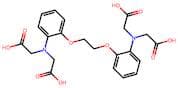
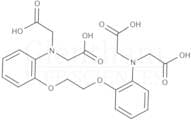
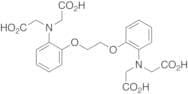
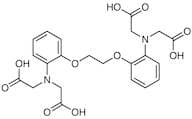
BAPTA, or bis-(o-aminophenoxy)-ethane-N,N,N',N'-tetraacetic acid, is a chelating agent primarily used for its ability to bind calcium ions with high specificity. It features a structure that includes two o-aminophenoxy groups and four acetic acid moieties, which facilitate its interaction with metal ions. BAPTA is particularly valued in biochemical research for its role in studying calcium signaling pathways, as it can effectively sequester calcium ions, thereby modulating cellular responses. The compound is often utilized in cell culture and physiological experiments to control intracellular calcium levels. BAPTA is known for its relatively low membrane permeability compared to other calcium chelators, making it suitable for applications where localized calcium buffering is required. Additionally, BAPTA can exist in various forms, including its free acid and various salt forms, which can influence its solubility and reactivity. Overall, BAPTA is a crucial tool in the fields of biochemistry and cell biology, aiding in the understanding of calcium's role in cellular processes.
Formula:C22H24N2O10
InChI:InChI=1S/C22H24N2O10/c25-19(26)11-23(12-20(27)28)15-5-1-3-7-17(15)33-9-10-34-18-8-4-2-6-16(18)24(13-21(29)30)14-22(31)32/h1-8H,9-14H2,(H,25,26)(H,27,28)(H,29,30)(H,31,32)
InChI key:InChIKey=FTEDXVNDVHYDQW-UHFFFAOYSA-N
SMILES:N(CC(O)=O)(CC(O)=O)C1=C(OCCOC2=C(N(CC(O)=O)CC(O)=O)C=CC=C2)C=CC=C1
Synonyms:- 1,2-Bis(o-aminophenoxy)ethane-N,N,N′,N′-tetraacetic acid
- 2,2',2'',2'''-[Ethane-1,2-Diylbis(Oxybenzene-2,1-Diylnitrilo)]Tetraacetate
- 2,2',2'',2'''-[Ethane-1,2-Diylbis(Oxybenzene-2,1-Diylnitrilo)]Tetraacetic Acid
- 2-[2-[2-[2-[Bis(carboxymethyl)amino]phenoxy]ethoxy]-N-(carboxymethyl)anilino]acetic acid
- Bapta
- Glycine, N,N′-[1,2-ethanediylbis(oxy-2,1-phenylene)]bis[N-(carboxymethyl)-
- N,N′-[1,2-Ethanediylbis(oxy-2,1-phenylene)]bis[N-(carboxymethyl)glycine]
- 1,2-Bis(2-aminophenoxy)ethane-N,N,N′,N′-tetraacetic acid
- 1,2-Bis(2-aminophenoxy)ethane-N,N,N',N'-tetraacetic Acid
Sort by
Purity (%)
0
100
|
0
|
50
|
90
|
95
|
100
Found 13 products.
BAPTA, 97%
CAS:Acts as a calcium chelatorBAPTA is used as a selective calcium chelating reagent. It is suitable for the spectrophotometric monitoring of calcium levels. It is a lipophilic diesters of the chelating agent used for the inhibition of proteolytic activities of certain metalloproteinases, calpain and trFormula:C22H24N2O10Purity:97%Color and Shape:White to pale cream to pale yellow, PowderMolecular weight:476.44Glycine,N,N'-[1,2-ethanediylbis(oxy-2,1-phenylene)]bis[N-(carboxymethyl)-
CAS:Formula:C22H24N2O10Purity:97%Color and Shape:SolidMolecular weight:476.43341,2-Bis(2-aminophenoxy)ethane-N,N,N',N'-tetraacetic acid
CAS:1,2-Bis(2-aminophenoxy)ethane-N,N,N',N'-tetraacetic acidFormula:C22H24N2O10Purity:97%Color and Shape: pale yellow solidMolecular weight:476.43335g/mol1,2-Bis(2-aminophenoxy)ethane-N,N,N'',N''-tetraacetic acid
CAS:Formula:C22H24N2O10Purity:≥ 97.0%Color and Shape:White to off-white or faint beige powderMolecular weight:476.44BAPTA (1,2-bis(o-Aminophenoxy)ethane-N,N,N',N'-tetra-Acetic Acid)
CAS:Formula:C22H24N2O10Molecular weight:476.44BAPTA
CAS:BAPTA is a neuroprotective agent in cerebral ischemia, acting as an intercellular Ca2+ chelator.Formula:C22H24N2O10Purity:97.21% - ≥95%Color and Shape:White SolidMolecular weight:476.43BAPTA
CAS:Controlled ProductApplications BAPTA is a highly selective calcium chelating reagent. Lipophilic diesters of the chelating agent 1,2-Bis(2 aminophenoxy)ethane-N,N,N',N'-tetraacetic acid (BAPTA) are used for inhibition of proteolytic activities of certain metalloproteinases, calpain and TACE.
References Tsien, R.Y., Biochemistry, 19, 2396 (1980), Wu, S.Y., et al.: J. Neurophysiology, 74, 2600 (1995), Venant, A., et al.: Biol. Cell, 85, 197 (1995), Tucker, T., et al.: Neuron, 15, 1323 (1995)Formula:C22H24N2O10Color and Shape:NeatMolecular weight:476.43BAPTA
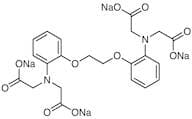
CAS:BAPTA is a fluorescent probe that binds to cytosolic calcium and can be used to measure intracellular calcium levels. It can also be used as a fluorescence probe for the measurement of mitochondrial membrane potential. BAPTA is a potent inhibitor of neuronal death induced by excess cytosolic calcium, which leads to activation of calcium-dependent proteases and cell lysis. The mechanism by which BAPTA inhibits neuronal death is unclear, but it may be due to its ability to modulate mitochondrial membrane potential or regulate Ca2+ release from intracellular stores. BAPTA has been shown to inhibit the polymerase chain reaction (PCR) in cells and tissues and can also inhibit the transcriptional activity of nuclear DNA. In addition, BAPTA can inhibit the function of ryanodine receptors in cells, leading to an increase in cytosolic Ca2+.Formula:C22H24N2O10Purity:Min. 97 Area-%Color and Shape:White PowderMolecular weight:476.43 g/molTetrasodium 1,2-Bis(2-aminophenoxy)ethane-N,N,N',N'-tetraacetate
CAS:Formula:C22H20N2Na4O10Purity:>98.0%(T)Color and Shape:White to Almost white powder to crystalMolecular weight:564.371,2-Bis(2-aminophenoxy)ethane-N,N,N',N'-tetraacetic Acid
CAS:Formula:C22H24N2O10Purity:>97.0%(HPLC)Color and Shape:White to Almost white powder to crystalMolecular weight:476.44
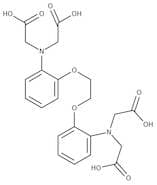

![Glycine,N,N'-[1,2-ethanediylbis(oxy-2,1-phenylene)]bis[N-(carboxymethyl)-](/_next/image/?url=https%3A%2Fstatic.cymitquimica.com%2Fproducts%2FIN%2Fthumb%2FDA00IDLE.jpg&w=3840&q=75)