CAS 85541-78-2
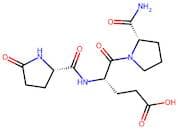
:pglu-glu-pro-amide
Description:
Pglu-glu-pro-amide, also known by its CAS number 85541-78-2, is a synthetic peptide that consists of a sequence of amino acids, specifically proline (Pro), glutamic acid (Glu), and potentially other modifications. This compound is characterized by its amide functional group, which influences its solubility and stability in biological systems. Peptides like Pglu-glu-pro-amide often exhibit specific biological activities, including potential roles in signaling pathways or as precursors to larger biomolecules. The presence of proline in the sequence can impart unique conformational properties, affecting the peptide's overall structure and function. Additionally, the amide bond contributes to the rigidity and stability of the peptide, making it resistant to enzymatic degradation. Such peptides are of interest in various fields, including pharmaceuticals and biochemistry, for their potential therapeutic applications and roles in cellular processes. However, detailed studies on its specific biological activity and applications would be necessary to fully understand its significance in research and industry.
Formula:C15H22N4O6
InChI:InChI=1/C15H22N4O6/c16-13(23)10-2-1-7-19(10)15(25)9(4-6-12(21)22)18-14(24)8-3-5-11(20)17-8/h8-10H,1-7H2,(H2,16,23)(H,17,20)(H,18,24)(H,21,22)/t8-,9-,10-/m0/s1
SMILES:C1C[C@@H](C(=N)O)N(C1)C(=O)[C@H](CCC(=O)O)N=C([C@@H]1CCC(=N1)O)O
Synonyms:- Pyroglutamyl-glutamyl-proline amide
- Fertilization promoting peptide
- Glp-glu-pronh2
- Pglu-glu-pronh2
- Pyroglutamyl-glutamyl-prolinamide
- Pyroglutamyl-glutamyl-prolineamide
- L-Prolinamide, 5-oxo-L-prolyl-L-alpha-glutamyl-
- 5-oxo-L-prolyl-L-alpha-glutamyl-L-prolinamide
- (Glu2)-TRH
- Pyr-Glu-Pro-NH2
Sort by
Purity (%)
0
100
|
0
|
50
|
90
|
95
|
100
Found 4 products.
(S)-5-((S)-2-Carbamoylpyrrolidin-1-yl)-5-oxo-4-((S)-5-oxopyrrolidine-2-carboxamido)pentanoic acid
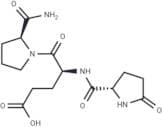
CAS:(S)-5-((S)-2-Carbamoylpyrrolidin-1-yl)-5-oxo-4-((S)-5-oxopyrrolidine-2-carboxamido)pentanoic acidPurity:99%Molecular weight:354.36g/mol(Glu2)-TRH
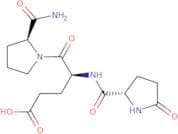
CAS:(Glu2)-TRH: Stable TRH analog; reduces TRH's cholinergic action; no thyroliberinase metabolism; neuroprotective with antidepressant, anticonvulsant effects.Formula:C15H22N4O6Color and Shape:SolidMolecular weight:354.36(Glu2)-TRH Pyr-Glu-Pro-NH2
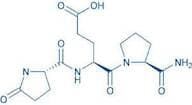
CAS:(Glu2)-TRH Pyr-Glu-Pro-NH2 is a colony-stimulating factor that has been shown to play a role in fertility and energy metabolism. It is also involved in the regulation of physiological functions, such as spermatozoa motility and enzyme inhibitors. (Glu2)-TRH Pyr-Glu-Pro-NH2 binds to its receptor on the surface of cells and stimulates cell growth. The biological function of this drug is not yet known.Formula:C15H22N4O6Purity:Min. 95%Molecular weight:354.36 g/mol(Glu²)-TRH
CAS:Fertilization-promoting peptide (FPP), a TRH analog, was previously purified and characterized from both rabbit prostate and human semen. Nanomolar concentrations of this peptide have been shown to enhance capacitation of mouse epididymal spermatozoa with a concomitant increase in fertilizing ability. It was also detected in the thyroid gland. According to a study of Nguyen et al. Pyr-Glu-Pro-NH₂ opposes the cholinergic effect of TRH in the mammalian CNS: Co-perfusion with an equivalent of TRH in the rat hippocampus resulted in a significant attenuation of TRH-induced acetylcholine release.Formula:C15H22N4O6Purity:98.6%Color and Shape:Whitish PowderMolecular weight:354.36