CAS 855763-18-7
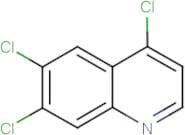
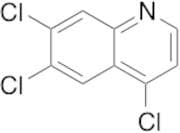
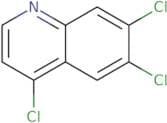
:4,6,7-trichloroquinoline
Description:
4,6,7-Trichloroquinoline is a synthetic organic compound characterized by its quinoline structure, which consists of a fused benzene and pyridine ring. The presence of three chlorine atoms at the 4, 6, and 7 positions of the quinoline ring significantly influences its chemical properties, including its reactivity and solubility. This compound typically appears as a solid and may exhibit a range of colors depending on its purity and form. It is known for its potential applications in pharmaceuticals, particularly in the development of antimicrobial agents and other therapeutic compounds. The chlorination enhances its biological activity, making it a subject of interest in medicinal chemistry. Additionally, 4,6,7-trichloroquinoline may exhibit moderate to low solubility in water but can dissolve in organic solvents, which is common for halogenated compounds. Safety data should be consulted, as halogenated compounds can pose environmental and health risks. Proper handling and disposal procedures are essential when working with this substance in a laboratory setting.
Formula:C9H4Cl3N
InChI:InChI=1/C9H4Cl3N/c10-6-1-2-13-9-4-8(12)7(11)3-5(6)9/h1-4H
SMILES:c1cnc2cc(c(cc2c1Cl)Cl)Cl
Synonyms:- Quinoline, 4,6,7-Trichloro-
- 4,6,7-Trichloroquinoline
Sort by
Purity (%)
0
100
|
0
|
50
|
90
|
95
|
100
Found 4 products.
4,6,7-Trichloroquinoline
CAS:4,6,7-TrichloroquinolinePurity:≥95%Color and Shape:SolidMolecular weight:232.49g/mol4,6,7-Trichloroquinoline
CAS:Controlled ProductApplications 4,6,7-trichloroquinoline (cas# 855763-18-7) is a useful research chemical.
Formula:C9H4NCl3Color and Shape:NeatMolecular weight:232.494,6,7-Trichloroquinoline
CAS:4,6,7-Trichloroquinoline is an anticancer drug that was first synthesized in the late 1950s. It is a type of 1,2-dihydroquinoline that has been modified by the addition of three chlorine groups. 4,6,7-Trichloroquinoline inhibits the growth of cancer cells by inducing DNA strand breaks and inhibiting DNA synthesis and protein synthesis. This drug also induces cell death through the release of reactive oxygen species. 4,6,7-Trichloroquinoline binds to tumor cells and inhibits their proliferation by binding to DNA molecules and preventing them from replicating. The hydrolysis process for this compound occurs in two steps: first it is hydrolyzed into diethylmalonate and ethoxymethylenemalonate; then it undergoes cyclization with condensation and decarboxylation to form a quinolinium salt.Formula:C9H4Cl3NPurity:Min. 95%Molecular weight:232.5 g/mol