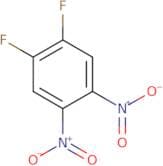
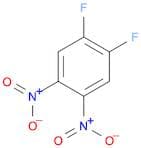
CAS 85686-97-1
:Benzene, 1,2-difluoro-4,5-dinitro-
Description:
Benzene, 1,2-difluoro-4,5-dinitro- is an aromatic compound characterized by the presence of a benzene ring substituted with two fluorine atoms and two nitro groups. The fluorine atoms are located at the 1 and 2 positions, while the nitro groups are positioned at the 4 and 5 positions of the benzene ring. This compound exhibits typical properties of aromatic compounds, including stability due to resonance. The presence of electronegative fluorine and nitro groups significantly influences its chemical reactivity, making it more susceptible to electrophilic substitution reactions. Additionally, the nitro groups contribute to the compound's potential as an explosive or a strong oxidizer, depending on the conditions. The compound is likely to be a solid at room temperature, with a relatively high melting point due to the strong intermolecular forces associated with the nitro groups. Safety precautions are essential when handling this substance, as both fluorinated and nitro compounds can pose health hazards. Overall, Benzene, 1,2-difluoro-4,5-dinitro- is a complex chemical with notable applications in various fields, including materials science and organic synthesis.
Formula:C6H2F2N2O4
Synonyms:- 1,2-Dinitro-4,5-difluorobenzene
Sort by
Purity (%)
0
100
|
0
|
50
|
90
|
95
|
100
Found 5 products.
1,2-Difluoro-4,5-dinitrobenzene
CAS:1,2-Difluoro-4,5-dinitrobenzeneFormula:C6H2F2N2O4Purity:>98%Color and Shape:SolidMolecular weight:204.0881,2-Difluoro-4,5-dinitrobenzene
CAS:1,2-Difluoro-4,5-dinitrobenzeneFormula:C6H2F2N2O4Purity:98%Molecular weight:204.091,2-Difluoro-4,5-dinitrobenzene
CAS:Formula:C6H2F2N2O4Purity:95%Color and Shape:SolidMolecular weight:204.0891,2-difluoro-4,5-dinitrobenzene
CAS:1,2-Difluoro-4,5-dinitrobenzene is a nitro compound that has been used extensively in supramolecular chemistry. The cavity of the molecule is able to bind with fatty esters and other molecules with lipophilic properties. This property can be exploited for the encapsulation of biomolecules and other organic compounds. 1,2-Difluoro-4,5-dinitrobenzene has also been found to be reactive towards carboxylic acid groups at room temperature and higher temperatures. The nature of this molecule is reactive as it reacts with carbodiimides to form cyclic urea derivatives.
Formula:C6H2F2N2O4Purity:Min. 95%Molecular weight:204.09 g/molBenzene, 1,2-difluoro-4,5-dinitro-
CAS:Formula:C6H2F2N2O4Purity:98%Color and Shape:SolidMolecular weight:204.0879