CAS 857429-79-9
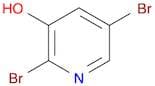
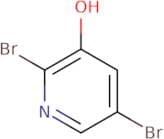
:2,5-dibromopyridin-3-ol
Description:
2,5-Dibromopyridin-3-ol is a chemical compound characterized by its pyridine ring, which is a six-membered aromatic heterocycle containing one nitrogen atom. The presence of two bromine substituents at the 2 and 5 positions of the pyridine ring, along with a hydroxyl (-OH) group at the 3 position, contributes to its unique chemical properties. This compound is typically a solid at room temperature and may exhibit moderate solubility in polar solvents due to the hydroxyl group, which can engage in hydrogen bonding. The bromine atoms enhance the compound's reactivity, making it a potential candidate for various chemical reactions, including nucleophilic substitutions and coupling reactions. Additionally, the presence of the hydroxyl group can influence its acidity and reactivity, allowing it to participate in further chemical transformations. 2,5-Dibromopyridin-3-ol may find applications in pharmaceuticals, agrochemicals, or as an intermediate in organic synthesis, owing to its functional groups and structural characteristics.
Formula:C5H3Br2NO
InChI:InChI=1S/C5H3Br2NO/c6-3-1-4(9)5(7)8-2-3/h1-2,9H
SMILES:c1c(cnc(c1O)Br)Br
Sort by
Purity (%)
0
100
|
0
|
50
|
90
|
95
|
100
Found 4 products.
2,5-DIBROMO-3-PYRIDINOL
CAS:Formula:C5H3Br2NOPurity:97%Color and Shape:SolidMolecular weight:252.89142,5-Dibromopyridin-3-ol
CAS:Formula:C5H3Br2NOPurity:97%(LC-MS);RGColor and Shape:Liquid, No data available.Molecular weight:252.8932,5-Dibromopyridin-3-ol
CAS:2,5-Dibromopyridin-3-ol is an organometallic compound that has been used as a reagent in the synthesis of polymers. It is also used as an intermediate in the preparation of palladium catalysts for the polymerization and cyclization of olefins. 2,5-Dibromopyridin-3-ol can react with cyanopyridine to produce a variety of functionalized polymers. The monomers formed from this reaction are stable and reactive and can be used for the synthesis of oligomers or polymers. 2,5-Dibromopyridin-3-ol reacts readily with halogens and proton donors to form bromides or alcohols respectively. These reactions involve nucleophilic attack on the electrophilic carbon atom adjacent to the bromine atom.Formula:C5H3Br2NOPurity:Min. 95%Molecular weight:252.89 g/mol