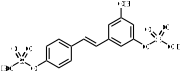
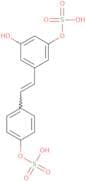
![3-Hydroxy-5-[(1E)-2-[4-(sulfooxy)phenyl]ethenyl]phenyl hydrogen sulfate](/_next/image/?url=https%3A%2Fstatic.cymitquimica.com%2Fcas-image%2Fthumb-webp%2F393856-3-hydroxy-5-1e-2-4-sulfooxy-phenyl-ethenyl-phenyl-hydrogen-sulfate.webp&w=3840&q=75)
CAS 858187-20-9
:3-Hydroxy-5-[(1E)-2-[4-(sulfooxy)phenyl]ethenyl]phenyl hydrogen sulfate
Description:
3-Hydroxy-5-[(1E)-2-[4-(sulfooxy)phenyl]ethenyl]phenyl hydrogen sulfate, with the CAS number 858187-20-9, is a chemical compound characterized by its complex structure, which includes a phenolic hydroxyl group and a sulfonate moiety. This compound features a conjugated system due to the presence of a vinyl group linked to a phenyl ring, which can contribute to its electronic properties and potential reactivity. The sulfooxy group enhances its solubility in water, making it more amenable for various applications, particularly in biological and environmental contexts. The presence of both hydroxyl and sulfonate functional groups suggests that it may exhibit acidic properties and can participate in hydrogen bonding, influencing its interactions with other molecules. Such characteristics may render it useful in fields like pharmaceuticals, where it could serve as a precursor or an active ingredient, as well as in materials science for developing functionalized surfaces or coatings. Overall, its unique structural features position it as a compound of interest for further research and application development.
Formula:C14H12O9S2
InChI:InChI=1S/C14H12O9S2/c15-12-7-11(8-14(9-12)23-25(19,20)21)2-1-10-3-5-13(6-4-10)22-24(16,17)18/h1-9,15H,(H,16,17,18)(H,19,20,21)/b2-1+
InChI key:InChIKey=DHYDAGFKCXRMSL-OWOJBTEDSA-N
SMILES:C(=C/C1=CC=C(OS(=O)(=O)O)C=C1)\C2=CC(OS(=O)(=O)O)=CC(O)=C2
Synonyms:- 1,3-Benzenediol, 5-[(1E)-2-[4-(sulfooxy)phenyl]ethenyl]-, mono(hydrogen sulfate)
- 1,3-Benzenediol, 5-[(1E)-2-[4-(sulfooxy)phenyl]ethenyl]-, 1-(hydrogen sulfate)
- 3-Hydroxy-5-[(1E)-2-[4-(sulfooxy)phenyl]ethenyl]phenyl hydrogen sulfate
Sort by
Purity (%)
0
100
|
0
|
50
|
90
|
95
|
100
Found 3 products.
trans-Resveratrol-3,4'-disulfate
CAS:Trans-Resveratrol-3,4'-disulfate is a sulfate conjugate of resveratrol, which is a natural polyphenolic compound. It is commonly derived from the metabolic processes involving resveratrol, a compound found in the skin of grapes, berries, and peanuts. As a metabolite, it is typically produced in the liver through sulfation, mediated by sulfotransferase enzymes. This conversion enhances the solubility and stability of resveratrol, potentially increasing its bioavailability compared to its parent compound.
Formula:C14H12O9S2Purity:Min. 95%Molecular weight:388.37 g/mol