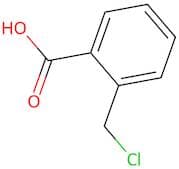
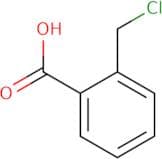
CAS 85888-81-9
:2-(chloromethyl)benzoic acid
Description:
2-(Chloromethyl)benzoic acid, with the CAS number 85888-81-9, is an aromatic carboxylic acid characterized by the presence of a chloromethyl group attached to the benzene ring. This compound typically appears as a white to off-white solid and is soluble in organic solvents, while exhibiting limited solubility in water due to its hydrophobic aromatic structure. The chloromethyl group introduces a reactive site, making it useful in various chemical reactions, including nucleophilic substitutions and coupling reactions. The carboxylic acid functional group contributes to its acidic properties, allowing it to participate in acid-base reactions. Additionally, this compound may exhibit biological activity, making it of interest in pharmaceutical and agrochemical research. Its reactivity and functional groups enable it to serve as an intermediate in the synthesis of more complex organic molecules. Safety precautions should be taken when handling this substance, as it may pose health risks due to its chlorinated nature and potential irritant properties.
Formula:C8H7ClO2
InChI:InChI=1/C8H7ClO2/c9-5-6-3-1-2-4-7(6)8(10)11/h1-4H,5H2,(H,10,11)
SMILES:c1ccc(c(c1)CCl)C(=O)O
Synonyms:- Benzoic Acid, 2-(Chloromethyl)-
- 2-Chloromethylbenzoic acid
- o-Chloromethylbenzoic acid
Sort by
Purity (%)
0
100
|
0
|
50
|
90
|
95
|
100
Found 4 products.
2-(Chloromethyl)benzoic acid
CAS:2-(Chloromethyl)benzoic acidFormula:C8H7ClO2Purity:99%Color and Shape: colourless to white. crystals / crystalline needlesMolecular weight:170.59g/mol2-(Chloromethyl)benzoic acid
CAS:Formula:C8H7ClO2Purity:98%Color and Shape:CrystallineMolecular weight:170.592-(Chloromethyl)benzoic acid
CAS:2-(Chloromethyl)benzoic acid (CMBA) is a reactive chemical that can be used as an oxidant or a carbanion. CMBA is activated by sulfinyl, alicyclic, and sulfoxides, which are organic compounds with one or more sulfur atoms. These reactions may be either alkylation or condensation reactions. The activated CMBA can then react with chlorine to form chlorinated products. This reaction can be catalyzed by low energy sources, such as light or heat.
Formula:C8H7ClO2Purity:Min. 95%Color and Shape:PowderMolecular weight:170.59 g/mol