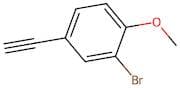
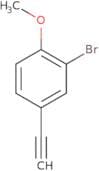
CAS 859211-28-2
:2-Bromo-4-ethynyl-1-methoxybenzene
Description:
2-Bromo-4-ethynyl-1-methoxybenzene, with the CAS number 859211-28-2, is an organic compound characterized by its aromatic structure, which includes a bromine substituent, an ethynyl group, and a methoxy group. This compound features a benzene ring, making it part of the class of aromatic compounds, known for their stability and unique reactivity due to delocalized π-electrons. The presence of the bromine atom introduces electrophilic characteristics, while the ethynyl group contributes to its reactivity in various coupling reactions, such as Sonogashira coupling. The methoxy group enhances the compound's solubility in organic solvents and can influence its electronic properties, potentially affecting its reactivity and interaction with other chemical species. 2-Bromo-4-ethynyl-1-methoxybenzene may be utilized in organic synthesis, particularly in the development of pharmaceuticals or advanced materials, due to its functional groups that allow for further chemical modifications. As with many organic compounds, safety precautions should be observed when handling this substance, as it may pose health risks.
Formula:C9H7BrO
InChI:InChI=1S/C9H7BrO/c1-3-7-4-5-9(11-2)8(10)6-7/h1,4-6H,2H3
InChI key:InChIKey=DKZNNVRSAHPVGF-UHFFFAOYSA-N
SMILES:C(#C)C1=CC(Br)=C(OC)C=C1
Synonyms:- Benzene, 2-bromo-4-ethynyl-1-methoxy-
- 2-Bromo-4-ethynyl-1-methoxybenzene
Sort by
Purity (%)
0
100
|
0
|
50
|
90
|
95
|
100
Found 3 products.
2-Bromo-4-ethynyl-1-methoxybenzene
CAS:2-Bromo-4-ethynyl-1-methoxybenzenePurity:98%Molecular weight:211.06g/mol2-Bromo-4-ethynyl-1-methoxybenzene
CAS:2-Bromo-4-ethynyl-1-methoxybenzene is a potent inhibitor of adenosine kinase, an enzyme that catalyzes the phosphorylation of adenosine to make it active. This agent has been shown to inhibit the activity of other enzymes in the adenosine pathway, such as phosphodiesterases and nucleoside transport proteins. 2-Bromo-4-ethynyl-1-methoxybenzene is not a nucleoside and does not act by binding to DNA or RNA. It has been shown to be effective in vivo and in vitro against lymphomas, leukemia, and breast cancer cells.
Formula:C9H7BrOPurity:Min. 95%Molecular weight:211.05 g/mol