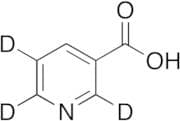
CAS 861405-75-6
:2,5,6-trideuteriopyridine-3-carboxylic acid
Description:
2,5,6-Trideuteriopyridine-3-carboxylic acid is a deuterated derivative of pyridine-3-carboxylic acid, which is characterized by the substitution of three hydrogen atoms with deuterium, a stable isotope of hydrogen. This compound features a pyridine ring, which is a six-membered aromatic ring containing one nitrogen atom, and a carboxylic acid functional group (-COOH) at the 3-position of the ring. The presence of deuterium enhances the compound's stability and alters its physical properties, such as boiling and melting points, compared to its non-deuterated counterpart. Deuterated compounds are often used in NMR spectroscopy and other analytical techniques due to their unique spectral signatures. Additionally, 2,5,6-trideuteriopyridine-3-carboxylic acid may have applications in pharmaceutical research, particularly in studies involving metabolic pathways or drug development, where tracking the behavior of specific isotopes can provide valuable insights. Its chemical behavior is largely similar to that of its non-deuterated analog, but the isotopic substitution can influence reaction kinetics and mechanisms.
Formula:C6H2D3NO2
InChI:InChI=1/C6H5NO2/c8-6(9)5-2-1-3-7-4-5/h1-4H,(H,8,9)/i1D,3D,4D
SMILES:c1(cc(c(nc1[2H])[2H])C(=O)O)[2H]
Sort by
The purity filter is not visible because current products do not have associated purity data for filtering.
Found 1 products.
Nicotinic Acid-d3 (major)
CAS:Controlled ProductApplications Labelled Nicotinic acid. It is a precursor of the coenzymes NAD and NADP. Widely distributed in nature; appreciable amounts are found in liver , fish, yeast and cereal grains. Dietary deficiency is associated with pellagra. The term “niacin” has also been applied to nicotinamide or to other derivatives exhibiting the biological activity of nicotinic acid. Vitamin (enzyme cofactor).A representative lot contains >20% d4.
References Darby, W.J., et al.: Nutr. Rev., 33, 289 (1975), Black, A., et al.: Eur. J. Clin. Nutr., 54, 395 (2000), Cole, T., et al.: Br. Med. J., 320, 1240 (2000), Forshee, R., et al.: J. Nutr., 134, 2733 (2004),Formula:C6H2D3NO2Color and Shape:NeatMolecular weight:126.13