CAS 861891-50-1
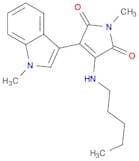
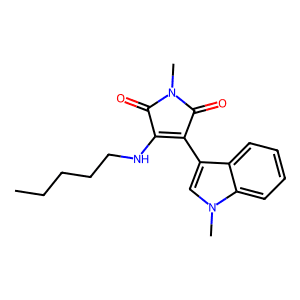
:1-methyl-3-(1-methylindol-3-yl)-4-(pentylamino)pyrrole-2,5-dione
Description:
1-Methyl-3-(1-methylindol-3-yl)-4-(pentylamino)pyrrole-2,5-dione, with the CAS number 861891-50-1, is a synthetic organic compound characterized by its complex molecular structure, which includes a pyrrole ring and an indole moiety. This compound features a methyl group and a pentylamino substituent, contributing to its unique chemical properties. It is likely to exhibit significant biological activity due to the presence of the indole and pyrrole functionalities, which are known to participate in various biochemical interactions. The compound may be soluble in organic solvents, and its stability can be influenced by environmental factors such as pH and temperature. Additionally, its potential applications could span across fields such as medicinal chemistry and materials science, although specific biological activities and mechanisms would require further investigation. As with many synthetic compounds, safety and handling precautions should be observed, particularly in laboratory settings.
Formula:C19H23N3O2
InChI:InChI=1/C19H23N3O2/c1-4-5-8-11-20-17-16(18(23)22(3)19(17)24)14-12-21(2)15-10-7-6-9-13(14)15/h6-7,9-10,12,20H,4-5,8,11H2,1-3H3
SMILES:CCCCCNC1=C(c2cn(C)c3ccccc23)C(=O)N(C)C1=O
Sort by
Purity (%)
0
100
|
0
|
50
|
90
|
95
|
100
Found 4 products.
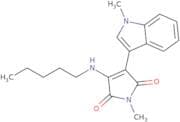
Necrosis Inhibitor, IM-54
CAS:Formula:C19H23N3O2Purity:99%Color and Shape:SolidMolecular weight:325.4048Necrosis Inhibitor, IM-54
CAS:IM-54 is a small molecule that inhibits necrotic cell death. It binds to the reactive oxygen species, which are generated during necrosis and disrupt cellular function. Xylitol dehydrogenase is an enzyme that converts xylitol into NADPH and increases autophagy in the cells. Autophagy is a process of self-digestion where damaged or unnecessary proteins are degraded by lysosomes. This process can be inhibited by IM-54, which may make it an anticancer agent because cancer cells depend on autophagy for survival. The basic structure of IM-54 has been found to inhibit polymerase chain reaction (PCR). This inhibition may be due to its ability to bind to the DNA template, thereby inhibiting the activity of DNA polymerase. IM-54 also has inhibitory effects on prostate cancer cells and murine hepatoma cells in culture, as well as Sprague Dawley rats with cancer.Formula:C19H23N3O2Purity:Min. 95%Molecular weight:325.4 g/molIM-54
CAS:IM-54 is a cell-permeable, effective, and selective necrosis inhibitor.Formula:C19H23N3O2Purity:99.24%Color and Shape:SolidMolecular weight:325.4