CAS 86604-80-0
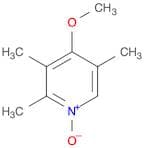
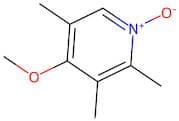
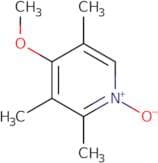
:Pyridine, 4-methoxy-2,3,5-trimethyl-, 1-oxide
Description:
Pyridine, 4-methoxy-2,3,5-trimethyl-, 1-oxide, commonly referred to as a pyridine derivative, is characterized by its aromatic heterocyclic structure, which includes a nitrogen atom within a six-membered ring. This compound features a methoxy group and three methyl groups at specific positions on the pyridine ring, contributing to its unique chemical properties. The presence of the nitrogen atom imparts basicity and potential nucleophilicity, while the methoxy group can influence the compound's reactivity and solubility in various solvents. Pyridine derivatives are often used in organic synthesis, pharmaceuticals, and as ligands in coordination chemistry. The 1-oxide designation indicates the presence of an oxygen atom bonded to the nitrogen, which can affect the compound's stability and reactivity. Overall, this compound exhibits characteristics typical of substituted pyridines, including potential applications in medicinal chemistry and as intermediates in the synthesis of more complex organic molecules.
Formula:C9H13NO2
InChI:InChI=1S/C9H13NO2/c1-6-5-10(11)8(3)7(2)9(6)12-4/h5H,1-4H3
InChI key:InChIKey=JOXZAMWCPXYFKC-UHFFFAOYSA-N
SMILES:O(C)C=1C(C)=C(C)N(=O)=CC1C
Synonyms:- 4-Methoxy-2,3,5-trimethylpyridine 1-oxide
- 4-Methoxy-2,3,5-trimethylpyridine N-oxide
- Pyridine, 4-methoxy-2,3,5-trimethyl-, 1-oxide
- 2,3,5-Trimethyl-4-methoxypyridine N-oxide
Sort by
Purity (%)
0
100
|
0
|
50
|
90
|
95
|
100
Found 6 products.
2,3,5-Trimethyl-4-methoxypyridine N-oxide
CAS:Formula:C9H13NO2Purity:95%Color and Shape:SolidMolecular weight:167.20504-Methoxy-2,3,5-trimethylpyridine-N-oxide
CAS:4-Methoxy-2,3,5-trimethylpyridine-N-oxidePurity:95%Molecular weight:167.21g/molOmeprazole Related Compound 6
CAS:Formula:C9H13NO2Color and Shape:Pale Yellow SolidMolecular weight:167.21N-Oxide-2,3,5-trimethyl-4-methoxypyridine
CAS:The compound N-oxide-2,3,5-trimethyl-4-methoxypyridine is an n-oxide of 2,3,5-trimethylpyridine. The n-oxide is the product of the substitution of a halogen atom attached to one of the methoxy groups on the pyridine ring. This reaction produces an acyloxylation with a methyl group or an alkylating agent that contains a halomethyl group. The reaction is catalyzed by nitric acid and proceeds in high yield.Formula:C9H13NO2Purity:Min. 95%Molecular weight:167.2 g/mol