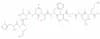
CAS 86933-74-6
:A-neurokinin
Description:
A-neurokinin, identified by its CAS number 86933-74-6, is a peptide that plays a significant role in the neuropeptide signaling pathways within the nervous system. It is primarily associated with the modulation of pain, inflammation, and various physiological processes. This substance is a member of the tachykinin family, which is characterized by a common structural motif and is known for its ability to bind to neurokinin receptors. A-neurokinin exhibits properties such as promoting smooth muscle contraction and influencing neurotransmitter release, thereby impacting both central and peripheral nervous system functions. Its biological activity is linked to various physiological responses, including vasodilation and the regulation of mood and stress responses. The peptide's stability, solubility, and interaction with specific receptors make it a subject of interest in pharmacological research, particularly in the context of developing therapeutic agents for conditions like pain management and neurodegenerative diseases. Understanding its characteristics and mechanisms of action is crucial for exploring its potential applications in medicine.
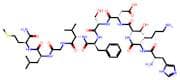
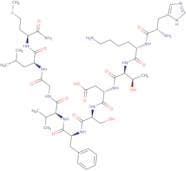
Formula:C50H80N14O14S
InChI:InChI=1/C50H80N14O14S/c1-26(2)18-34(45(73)58-32(42(53)70)15-17-79-6)57-38(67)23-55-49(77)40(27(3)4)63-47(75)35(19-29-12-8-7-9-13-29)60-48(76)37(24-65)62-46(74)36(21-39(68)69)61-50(78)41(28(5)66)64-44(72)33(14-10-11-16-51)59-43(71)31(52)20-30-22-54-25-56-30/h7-9,12-13,22,25-28,31-37,40-41,65-66H,10-11,14-21,23-24,51-52H2,1-6H3,(H2,53,70)(H,54,56)(H,55,77)(H,57,67)(H,58,73)(H,59,71)(H,60,76)(H,61,78)(H,62,74)(H,63,75)(H,64,72)(H,68,69)
SMILES:CC(C)CC(C(=NC(CCSC)C(=N)O)O)N=C(CN=C(C(C(C)C)N=C(C(Cc1ccccc1)N=C(C(CO)N=C(C(CC(=O)O)N=C(C(C(C)O)N=C(C(CCCCN)N=C(C(Cc1cnc[nH]1)N)O)O)O)O)O)O)O)O
Synonyms:- Neurokinin A
- L-Methioninamide, L-histidyl-L-lysyl-L-threonyl-L-alpha-aspartyl-L-seryl-L-phenylalanyl-L-valylglycyl-L-leucyl-
- Neurokinin A (Python molurus)
- Neurokinin A (alligator)
- Neurokinin A (pig spinal cord)
- Neurokinin alpha
- Neurokinin alpha (pig spinal cord)
- Neurokinin alpha (porcine)
- Neuromedin L
- Neuromedin L (pig spinal cord)
- Porcine neurokinin A
- Substance K
- Kassinin, 1-de-L-aspartic acid-2-de-L-valine-3-L-histidine-5-L-threonine-7-L-serine-
- Neurokinin A (swine spinal cord)
- Histidyllysylthreonyl-Alpha-Aspartylserylphenylalanylvalylglycylleucylmethioninamide
- See more synonyms
Sort by
Purity (%)
0
100
|
0
|
50
|
90
|
95
|
100
Found 6 products.
Neurokinin A
CAS:For cellular and molecular biology applications
Formula:C50H80N14O14SMolecular weight:1133.33Neurokinin A
CAS:Bachem ID: 4011920.
Formula:C50H80N14O14SPurity:99.3%Color and Shape:White PowderMolecular weight:1133.34Neurokinin A
CAS:Neurokinin A (NKA), formerly known as Substance K, is a neurologically active peptide translated from the pre-protachykinin gene.Formula:C50H80N14O14SPurity:>99.99%Color and Shape:White To Off-White Lyophilized SolidMolecular weight:1133.32Neurokinin A (Human, Porcine, Rat, Mouse)
CAS:Neurokinin A is a peptide that belongs to the tachykinin family and has been shown to activate receptors, such as NK-1. It is a potent inhibitor of ion channels and has also been shown to inhibit ligand binding to the receptor. Neurokinin A is used in research for studying protein interactions, receptor effects, peptides, and ion channels. It can be used in cell biology for studying life science and research tools for high purity and antibody production. This product is not intended for therapeutic use.
Formula:C50H80N14O14SPurity:Min. 95%Molecular weight:1,133.3 g/molNeurokinin A trifluoroacetate salt
CAS:Neurokinin A trifluoroacetate salt H-His-Lys-Thr-Asp-Ser-Phe-Val-Gly-Leu-Met-NH2 trifluoroacetate salt is a potent inducer of the basic protein. It has been shown to have cytotoxic effects on pluripotent cells in vitro. Neurokinin A is also a potent inducer of substance P, which is a neurotransmitter that mediates inflammatory lesions and cardiac effects. Neurokinin A has also been shown to have an effect on locomotor activity and polymerase chain reaction (PCR) amplification in vitro.Formula:C50H80N14O14SPurity:Min. 95%Molecular weight:1,133.32 g/mol