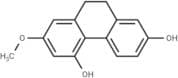
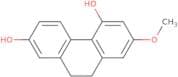
CAS 87530-30-1
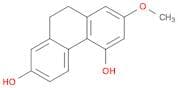
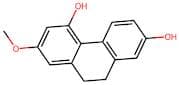
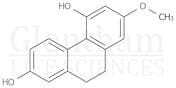
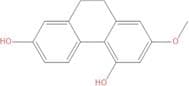
:Lusianthridin
Description:
Lusianthridin, identified by its CAS number 87530-30-1, is a chemical compound that belongs to a class of substances known for their potential biological activities. While specific details about its physical and chemical properties may not be widely documented, compounds in this category often exhibit characteristics such as moderate to high solubility in organic solvents, varying degrees of stability under different environmental conditions, and potential reactivity with various functional groups. Lusianthridin may also possess pharmacological properties, making it of interest in medicinal chemistry and drug development. Its structure likely includes specific functional groups that contribute to its biological activity, although detailed structural information would be necessary for a comprehensive understanding. As with many chemical substances, safety data and handling precautions are essential for laboratory work, and further research may be required to fully elucidate its properties and applications.
Formula:C15H14O3
InChI:InChI=1S/C15H14O3/c1-18-12-7-10-3-2-9-6-11(16)4-5-13(9)15(10)14(17)8-12/h4-8,16-17H,2-3H2,1H3
InChI key:InChIKey=RDKDIPDDUFMMMT-UHFFFAOYSA-N
SMILES:OC1=C2C=3C(CCC2=CC(OC)=C1)=CC(O)=CC3
Synonyms:- Lusianthridin
- 2,5-Phenanthrenediol, 9,10-dihydro-7-methoxy-
- 9,10-Dihydro-7-methoxy-2,5-phenanthrenediol
Sort by
Purity (%)
0
100
|
0
|
50
|
90
|
95
|
100
Found 6 products.
Lusianthridin
CAS:Lusianthridin is a natural product from Dendrobium venustum.Formula:C15H14O3Purity:98.49%Color and Shape:SolidMolecular weight:242.27Lusianthridin
CAS:Lusianthridin is a natural product that has been shown to have antibacterial and antioxidant properties. It can be extracted from the leaves of the plant Lusiana, but can also be synthesized in the laboratory. Lusianthridin is usually used as an extractant or as an antioxidant in research. It has also been shown to have a protective effect against liver disease and cancer, which may be due to its ability to stimulate metformin-mediated apoptosis.Formula:C15H14O3Purity:Min. 95%Molecular weight:242.27 g/mol