CAS 876890-33-4
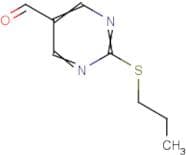
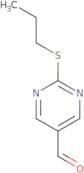
:2-(propylsulfanyl)pyrimidine-5-carbaldehyde
Description:
2-(Propylsulfanyl)pyrimidine-5-carbaldehyde is a chemical compound characterized by its pyrimidine ring structure, which is a six-membered aromatic heterocycle containing two nitrogen atoms at positions 1 and 3. The presence of a propylsulfanyl group at the 2-position introduces a sulfur atom into the molecule, contributing to its unique reactivity and potential applications in organic synthesis and medicinal chemistry. The aldehyde functional group at the 5-position is indicative of its potential as a reactive intermediate, allowing for further chemical modifications. This compound may exhibit properties such as solubility in organic solvents, and its reactivity can be influenced by the electron-withdrawing nature of the aldehyde and the electron-donating characteristics of the propylsulfanyl group. Its structural features suggest potential applications in pharmaceuticals, agrochemicals, or as a building block in organic synthesis. As with many heterocyclic compounds, its biological activity and interactions would depend on the specific functional groups and their spatial arrangement within the molecule.
Formula:C8H10N2OS
InChI:InChI=1/C8H10N2OS/c1-2-3-12-8-9-4-7(6-11)5-10-8/h4-6H,2-3H2,1H3
SMILES:CCCSc1ncc(cn1)C=O
Synonyms:- 5-Pyrimidinecarboxaldehyde, 2-(Propylthio)-
Sort by
Purity (%)
0
100
|
0
|
50
|
90
|
95
|
100
Found 2 products.
2-Propylsulfanyl-pyrimidine-5-carbaldehyde
CAS:2-Propylsulfanyl-pyrimidine-5-carbaldehydePurity:95%Molecular weight:182.24g/mol2-(Propylthio)pyrimidine-5-carbaldehyde
CAS:2-(Propylthio)pyrimidine-5-carbaldehyde (2-PSPCA) is a novel, modified ribonucleoside that has been shown to activate the DNA polymerase. 2-PSPCA has been used in the synthesis of deoxyribonucleosides and phosphoramidites for use in the research and development of antiviral agents and anticancer drugs. 2-PSPCA is a monophosphate with an IC50 of 0.6 mM against human leukemia cells.Formula:C8H10N2OSPurity:Min. 95%Molecular weight:182.24 g/mol