CAS 87745-27-5
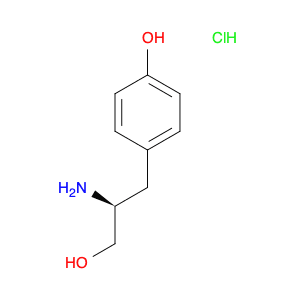
:L-Tyrosinol hydrochloride
Description:
L-Tyrosinol hydrochloride is a chemical compound that is a derivative of the amino acid tyrosine, characterized by the presence of a hydroxyl group on the aromatic ring. It is typically encountered as a white to off-white crystalline powder, which is soluble in water and exhibits hygroscopic properties. The compound is often used in biochemical research and pharmaceutical applications due to its role as a building block in protein synthesis and its potential neuroprotective effects. L-Tyrosinol hydrochloride can participate in various biochemical pathways, including those related to neurotransmitter synthesis, particularly dopamine. Its hydrochloride form enhances its stability and solubility, making it suitable for various formulations. As with many amino acid derivatives, it is important to handle L-Tyrosinol hydrochloride with care, adhering to safety protocols, as it may have specific reactivity or toxicity profiles depending on the context of use. Overall, L-Tyrosinol hydrochloride is a valuable compound in both research and therapeutic settings.
Formula:C9H14ClNO2
InChI:InChI=1/C9H13NO2.ClH/c10-8(6-11)5-7-1-3-9(12)4-2-7;/h1-4,8,11-12H,5-6,10H2;1H/t8-;/m0./s1
SMILES:c1cc(ccc1C[C@@H](CO)N)O.Cl
Synonyms:- 4-[(2S)-2-Amino-3-hydroxypropyl]phenol hydrochloride
- 4-[(2S)-2-Amino-3-hydroxypropyl]phenol hydrochloride (1:1)
- benzenepropanol, β-amino-4-hydroxy-, (betaS)-, hydrochloride (1:1)
- (2S)-1-hydroxy-3-(4-hydroxyphenyl)propan-2-aminium chloride
Sort by
Purity (%)
0
100
|
0
|
50
|
90
|
95
|
100
Found 5 products.
L-Tyrosinol hydrochloride
CAS:Formula:C9H14ClNO2Purity:98%Color and Shape:SolidMolecular weight:203.6660(S)-4-(2-Amino-3-hydroxypropyl)phenol hydrochloride
CAS:Formula:C9H14ClNO2Purity:95.0%Color and Shape:White crystalline powderMolecular weight:203.67L-Tyrosinol hydrochloride
CAS:L-Tyrosinol hydrochloride is a chiral molecule that is the hydrogenated form of L-tyrosine. It is an intermediate in the synthesis of L-dopa, which is used to treat Parkinson's disease. The enzymatic reaction that converts L-tyrosinol hydrochloride to L-dopa requires adenosine 5'-phosphosulfate as cofactor and histidine as a catalyst. The conversion of L-tyrosinol hydrochloride to L-dopa occurs with high yield and has been shown to be stereoselective. This synthetic pathway has been shown to have an activation energy of 53 kcal/mol and a reaction time of 30 minutes at room temperature.Formula:C9H13NO2·HClColor and Shape:White Off-White PowderMolecular weight:203.67 g/mol