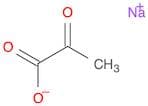
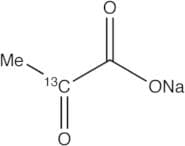
CAS 87976-70-3
:pyruvic-2-13C acid, sodium salt
Description:
Pyruvic-2-13C acid, sodium salt, is a stable isotopic form of pyruvic acid where the carbon atom at position 2 is replaced with the carbon-13 isotope. This compound is typically used in metabolic studies and tracer experiments due to its ability to provide insights into metabolic pathways and carbon flux in biological systems. As a sodium salt, it is soluble in water, making it suitable for various biochemical applications. The presence of the 13C isotope allows for enhanced detection and analysis using nuclear magnetic resonance (NMR) spectroscopy and mass spectrometry. Pyruvic acid itself is a key intermediate in several metabolic pathways, including glycolysis and the citric acid cycle, and its sodium salt form is often utilized in laboratory settings for research involving cellular metabolism and energy production. The compound is generally considered safe for use in research, although standard laboratory safety protocols should be followed.
Formula:C3H3NaO3
InChI:InChI=1/C3H4O3.Na/c1-2(4)3(5)6;/h1H3,(H,5,6);/q;+1/p-1/i2+1;
SMILES:CC(=O)C(=O)O.[Na]
Synonyms:- sodium 2-oxo(2-13C)propanoate
- Pyruvic-2-13C acid sodium salt
- pyruvic acid-2-13c sodium salt
- PYRUVIC-2-13C ACID, SODIUM SALT, 99 ATOM % 13C
- SODIUM PYRUVATE (2-13C)
- [2-13C]-Sodium Pyruvate
Sort by
Purity (%)
0
100
|
0
|
50
|
90
|
95
|
100
Found 3 products.
Pyruvic Acid-2-13C Sodium Salt
CAS:Controlled ProductApplications Labelled Pyruvic acid (P998900). Intermediate in sugar metabolism and in enzymatic carbohydrate degradation (alcoholic fermentation) where it is converted to acetaldehyde and CO2 by carboxylase. In muscle, Pyruvic acid (derived from glycogen) is reduced to lactic acid during exertion, which is reoxidized and partially retransformed to glycogen during rest. The liver can convert Pyruvic acid to alanine by amination. A diagnostic agent for Parkinson disease.
References Wenzel, A., et al.: J. Neurosci., 21, 53 (2001), Martinez., et al.: Development, 6, 851 (2002), Nakayama, K., et al.: J. Biochem., 146, 757 (2009), Tanaka, T., et al.: J. Pharmacol. Sci., 109, 24 (2009),Formula:C213CH3NaO3Color and Shape:NeatMolecular weight:111.04