CAS 88-58-4
:2,5-Di-tert-butylhydroquinone
Description:
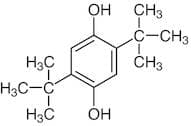
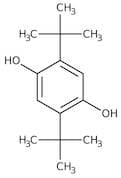
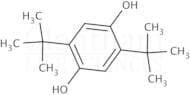
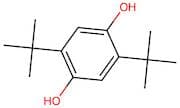
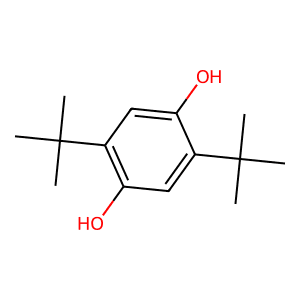
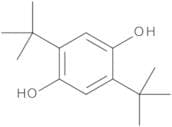
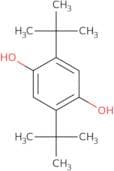
2,5-Di-tert-butylhydroquinone (CAS 88-58-4) is an organic compound that belongs to the class of hydroquinones, which are characterized by their dihydroxybenzene structure. This compound features two tert-butyl groups attached to the 2 and 5 positions of the hydroquinone ring, enhancing its lipophilicity and stability. It appears as a white to pale yellow crystalline solid and is known for its antioxidant properties, making it useful in various applications, particularly in the food and cosmetic industries as a preservative to prevent oxidation. The compound is relatively stable under normal conditions but can undergo oxidation to form quinone derivatives. Its solubility is higher in organic solvents than in water, which is typical for compounds with bulky substituents. Additionally, 2,5-Di-tert-butylhydroquinone is considered to have low toxicity, but safety precautions should still be observed when handling it in laboratory or industrial settings. Overall, its unique structure and properties make it a valuable compound in various chemical applications.
Formula:C14H22O2
InChI:InChI=1S/C14H22O2/c1-13(2,3)9-7-12(16)10(8-11(9)15)14(4,5)6/h7-8,15-16H,1-6H3
InChI key:InChIKey=JZODKRWQWUWGCD-UHFFFAOYSA-N
SMILES:C(C)(C)(C)C1=C(O)C=C(C(C)(C)C)C(O)=C1
Synonyms:- 1,4-Benzenediol, 2,5-bis(1,1-dimethylethyl)-
- 1,4-Dihydroxy-2,5-di-tert-butylbenzene
- 2,5-Bis(1,1-dimethylethyl)-1,4-benzenediol
- 2,5-Bis(2-Methyl-2-Propyl)-1,4-Benzenediol
- 2,5-Di-Tert-Butyl-1,4-Hydroquinone
- 2,5-Di-tert-butyl-1,4-benzenediol
- 2,5-Di-tert-butyl-1,4-benzohydroquinone
- 2,5-Di-tert-butyl-1,4-dihydroxybenzene
- 2,5-Di-tert-butylquinol
- 2,5-Dihydroxy-1,4-di-tert-butylbenzene
- 2,5-Ditert-butylbenzene-1,4-diol
- 3,6-Di-tert-butylhydroquinone
- Antage DBH
- Antioxidant Alba
- Antioxidant DBH
- Antioxidant NS 7
- BHQ
- Butylhydroquinone-Tert
- Dbhq
- Dibug
- Dibutylhydroquinone
- Dtbhq
- Hydroquinone, 2,5-di-tert-butyl-
- NSC 11
- NSC 9886
- Naugard 451
- Nocrac NS 7
- Nonflex Alba
- See more synonyms
Sort by
Purity (%)
0
100
|
0
|
50
|
90
|
95
|
100
Found 12 products.
2,5-Di-tert-butylhydroquinone
CAS:Formula:C14H22O2Purity:>98.0%(GC)Color and Shape:White to Light yellow to Light red powder to crystalMolecular weight:222.332,5-Di-tert-butylhydroquinone, 98+%
CAS:This Thermo Scientific Chemicals brand product was originally part of the Alfa Aesar product portfolio. Some documentation and label information may refer to the legacy brand. The original Alfa Aesar product / item code or SKU reference has not changed as a part of the brand transition to Thermo SciFormula:C14H22O2Purity:98+%Color and Shape:Crystals or powder or crystalline/granular powder, White to cream to pink to pale brownMolecular weight:222.332,5-Di-tert-butylhydroquinone
CAS:Formula:C14H22O2Purity:95%Color and Shape:SolidMolecular weight:222.32332,5-Di-tert-butylhydroquinone
CAS:Formula:C14H22O2Purity:≥ 98.0%Color and Shape:White to off-white or pale brown-orange powder or crystalsMolecular weight:222.332,5-Di-tert-butylhydroquinone
CAS:2,5-Di-tert-butylhydroquinonePurity:≥95%Molecular weight:222.32g/mol2,5-Bis(tert-butyl)benzene-1,4-diol
CAS:2,5-Bis(tert-butyl)benzene-1,4-diolPurity:≥95%Molecular weight:222.32g/mol2,5-Di-tert-butylhydroquinone
CAS:Formula:C14H22O2Purity:99.00%Color and Shape:SolidMolecular weight:222.3282,5-Di-tert-butylhydroquinone
CAS:2,5-Di-tert-butylhydroquinone (BHQ) is an effective and selective endoplasmic reticulum Ca2+-ATPase inhibitor.Formula:C14H22O2Purity:97.11%Color and Shape:PelletslargecrystalsMolecular weight:222.322,5-Di-tert-butylhydroquinone
CAS:2,5-Di-tert-butylhydroquinone is a potent inhibitor of the two major phospholipases that regulate intracellular Ca2+ levels. It also inhibits epidermal growth factor (EGF) production in rat liver microsomes, and has been shown to inhibit the activity of cytosolic Ca2+/calmodulin-dependent protein kinase II (CAMKII), which regulates cell proliferation. 2,5-Di-tert-butylhydroquinone has also been shown to be a potent inducer of monoclonal antibody production in mice and is used as an adjuvant for the treatment of prostate cancer cells. This compound is metabolized by cytochrome P450 enzymes in liver cells and cardiac cells.Formula:C14H22O2Purity:Min. 95%Color and Shape:White PowderMolecular weight:222.32 g/mol