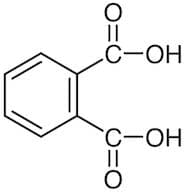
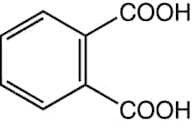
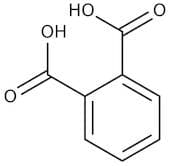
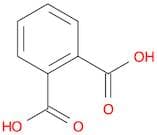
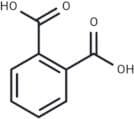
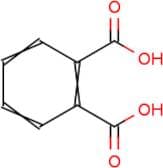
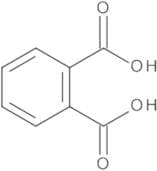
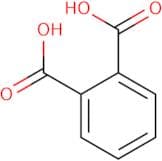
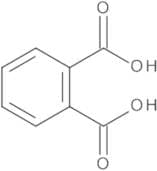
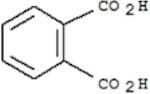
CAS 88-99-3
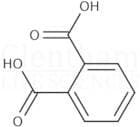
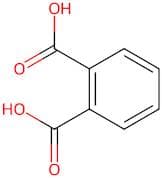
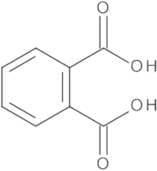
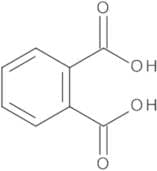
:Phthalic acid
- 1,2-Benzenedicarboxylic acid
- Acide phtalique
- Acido Ftalico
- Benzene-1,2-Dicarboxylate
- Benzene-1,2-dicarboxylic acid
- M 2
- Nsc 5348
- O-Benzenedicarboxylic Acid
- Orthophthalic acid
- Pathalic acid
- Phthalsaeure
- Phthalsaure
- Sunftal 20
- o-Carboxybenzoic acid
- o-Dicarboxybenzene
- o-Phthalic Acid
- See more synonyms
Phthalic Acid
CAS:Formula:C8H6O4Purity:>99.0%(GC)(T)Color and Shape:White powder to crystalMolecular weight:166.13Phthalic acid, ACS, 99.5+%
CAS:Phthalic acid is used as an active ingredient in polyesters and alkyd resins. It is also used as plasticizers for polyvinyl chloride and other polymers. It is also useful in the production of anthraquinone, phenolphthalein and phthalocyanine pigments. It serves as an organic reagent in the productioFormula:C8H6O4Purity:99.5+%Molecular weight:166.13Phthalic acid, 99%
CAS:Phthalic acid is used as an active ingredient in polyesters and alkyd resins. It is also used as plasticizers for polyvinyl chloride and other polymers. It is also useful in the production of anthraquinone, phenolphthalein and phthalocyanine pigments. It serves as an organic reagent in the productioFormula:C8H6O4Purity:99%Color and Shape:White, Crystals or powder or crystalline powderMolecular weight:166.13Phthalic Acid
CAS:Aromatic polycarboxylic acids, their anhydrides, halides, peroxides, peroxyacids etc not elsewhere specified or includedFormula:C8H6O4Color and Shape:White PowderMolecular weight:166.02661Phthalic acid
CAS:Formula:C8H6O4Purity:99.0 - 101.0 % (dried basis)Color and Shape:White to almost white crystalline powderMolecular weight:166.13Benzene-1,2-dicarboxylic Acid (Phthalic Acid)
CAS:Controlled ProductFormula:C8H6O4Color and Shape:NeatMolecular weight:166.13Phthalic acid
CAS:Phthalic acid (1,2-Benzenedioic acid) is an aromatic dicarboxylic acid. It is a human xenobiotic metabolite.Formula:C8H6O4Purity:99.31%Color and Shape:Colourless Solid CrystallineMolecular weight:166.13Phthalic acid
CAS:Phthalic acidFormula:C8H6O4Purity:99%Color and Shape: white solidMolecular weight:166.13g/molPhthalic acid
CAS:Formula:C8H6O4Purity:95%Color and Shape:Solid, Crystalline or PowderMolecular weight:166.132Phthalic Acid
CAS:Stability Hygroscopic
Applications Organic reagent used to synthesize phthalates.
References Duchowicz, P.R., et al.: Bioorg. Med. Chem., 16, 7944 (2008), di Luccio, E., et al.: Biochem., 47, 4039 (2008), Lopez, Z., et al.: App. Microbiol. Biotechnol., 78, 739 (2008), Hong, Y., et al.: Toxicol. Lett., 184, 139 (2009),Formula:C8H6O4Color and Shape:ColourlessMolecular weight:166.13Phthalic acid
CAS:Phthalic acid is a chemical compound that is used in wastewater treatment. It is also used as an intermediate for the production of other chemicals. Phthalic acid has been shown to inhibit the activity of the ryanodine receptor, which is a protein found on the surface of muscle cells that regulates calcium uptake and release. This inhibition leads to an increase in free intracellular calcium levels, which can cause toxicity by disrupting cellular function and leading to cell death. The effects of phthalate on mitochondrial membrane potential are also being studied. Phthalic acid has been shown to cause acute toxicities in wild-type strains, but not mutant strains of yeast. The analytical method for phthalate includes gas chromatography with mass spectrometry detection (GC-MS). Toxicity studies have been conducted using various methods, including acute toxicity studies, subchronic toxicity studies, and chronic toxicity studies.
Formula:C8H6O4Purity:Min. 98 Area-%Color and Shape:White PowderMolecular weight:166.13 g/molPhthalic Acid (Phenyl-13C6, D4)
CAS:Controlled ProductFormula:C6C2H2D4O4Color and Shape:NeatMolecular weight:166.13Phthalic Acid pure, 99%
CAS:Formula:C8H6O4Purity:min. 99%Color and Shape:White, Crystalline compound, Clear, ColourlessMolecular weight:166.14