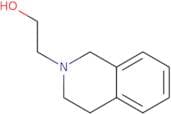
CAS 88014-15-7
:2-(3,4-dihydroisoquinolin-2(1H)-yl)ethanol
Description:
2-(3,4-Dihydroisoquinolin-2(1H)-yl)ethanol, with the CAS number 88014-15-7, is an organic compound characterized by its unique structure, which includes a dihydroisoquinoline moiety and an ethanol group. This compound typically exhibits properties associated with both aromatic and aliphatic systems, contributing to its potential biological activity. It is likely to be a colorless to pale yellow liquid or solid, depending on its purity and form. The presence of the hydroxyl (-OH) group in the ethanol portion suggests it may engage in hydrogen bonding, influencing its solubility in polar solvents like water and alcohols. Additionally, the isoquinoline structure may impart pharmacological properties, making it of interest in medicinal chemistry for potential applications in drug development. Its reactivity can be influenced by the functional groups present, allowing for various chemical transformations. Overall, this compound represents a fascinating intersection of structural complexity and potential utility in chemical and pharmaceutical research.
Formula:C11H15NO
InChI:InChI=1/C11H15NO/c13-8-7-12-6-5-10-3-1-2-4-11(10)9-12/h1-4,13H,5-9H2
SMILES:c1ccc2CN(CCc2c1)CCO
Sort by
Purity (%)
0
100
|
0
|
50
|
90
|
95
|
100
Found 2 products.
2-(3,4-dihydroisoquinolin-2(1H)-yl)ethanol
CAS:Formula:C11H15NOPurity:95.0%Color and Shape:Liquid, No data available.Molecular weight:177.2472-(3,4-Dihydroisoquinolin-2(1H)-yl)ethanol
CAS:2-(3,4-Dihydroisoquinolin-2(1H)-yl)ethanol is a quinoline derivative that has been shown to inhibit the growth of tumour cells. It has been shown to induce cell death in hepatoma cell lines and inhibit the proliferation of human tumour cells. This compound binds to choline receptors on the surface of cancer cells, inhibiting the release of neurotransmitter acetylcholine which is involved in many cellular processes including muscle contraction and nerve conduction. 2-(3,4-Dihydroisoquinolin-2(1H)-yl)ethanol also inhibits lipid peroxidation and induces apoptosis by binding to iron in mitochondria.Formula:C11H15NOPurity:Min. 95%Molecular weight:177.24 g/mol