CAS 881-99-2
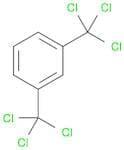
:1,3-Bis(trichloromethyl)benzene
Description:
1,3-Bis(trichloromethyl)benzene, also known as benzene, 1,3-bis(trichloromethyl)-, is an aromatic compound characterized by the presence of two trichloromethyl groups (-CCl3) attached to the benzene ring at the 1 and 3 positions. This compound is typically a colorless to pale yellow solid at room temperature and has a distinct, strong odor. It is known for its high density and low solubility in water, but it is soluble in organic solvents. The presence of multiple chlorine atoms contributes to its chemical stability and reactivity, making it a subject of interest in various chemical syntheses and applications. However, due to the toxicity associated with chlorinated compounds, it poses environmental and health risks, necessitating careful handling and disposal. Additionally, it may undergo reactions typical of aromatic compounds, such as electrophilic substitution, and can be involved in the formation of more complex chemical structures in synthetic organic chemistry.
Formula:C8H4Cl6
InChI:InChI=1S/C8H4Cl6/c9-7(10,11)5-2-1-3-6(4-5)8(12,13)14/h1-4H
InChI key:InChIKey=GGZIUXGYCNYNNV-UHFFFAOYSA-N
SMILES:C(Cl)(Cl)(Cl)C1=CC(C(Cl)(Cl)Cl)=CC=C1
Synonyms:- 1,3-Di(trichloromethyl)benzene
- 3-(Trichloromethyl)benzotrichloride
- Alpha,Alpha,Alpha,Alpha',Alpha',Alpha'-Hexachloro-M-Xylene
- Benzene, 1,3-bis(trichloromethyl)-
- Hexachloro-m-Xylene
- NSC 41882
- m-Bis(trichloromethyl)benzene
- m-Xylene, α,α,α,α′,α′,α′-hexachloro-
- α,α,α,α′,α′,α′-Hexachloro-m-xylene
- 1,3-Bis(trichloromethyl)benzene
- m-bis(trichlormethyl)benzene
- alpha,alpha,alpha,alpha’,alpha’,alpha’-hexachloro-m-xylen
- 1,3-bis(trichloromethyl)benzoyl
- M-XYLENE HEXACHLORIDE
- alpha,alpha’-hexachloro-m-xylene
- hexachlorometaxylol
- 1,3-bis(trichloromethyl)-benzen
- alpha,alpha,alpha,alpha’,alpha’,alpha’-hexachloroxylene
- See more synonyms
Sort by
Purity (%)
0
100
|
0
|
50
|
90
|
95
|
100
Found 2 products.
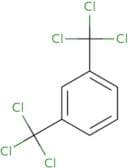
1,3-Bis(trichloromethyl)benzene
CAS:1,3-Bis(trichloromethyl)benzene is a chlorinated hydrocarbon that is used as an intermediate in the industrial production of pharmaceuticals. It is produced by heating chlorine with benzene in the presence of a catalyst, such as cocl2. The reaction produces hydrogen chloride and 1,3-bis(trichloromethyl)benzene. The synthesis process may be carried out in either an organic or aqueous solvent. Hydrogen chloride gas is generated during the process and can be released into the environment during production or processing. Irradiation may also be used to produce 1,3-bis(trichloromethyl)benzene. 1,3-Bis(trichloromethyl)benzene is not toxic to humans because it does not react with human tissues and cells. However, it has been shown to cause liver cancer in rats when they were exposed to high doses overFormula:C8H4Cl6Purity:Min. 95%Molecular weight:312.84 g/mol