CAS 88111-74-4
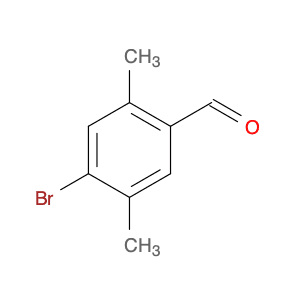
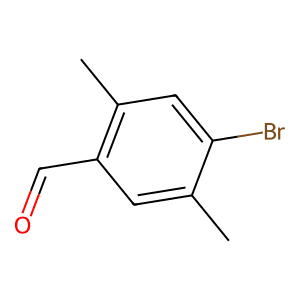
:4-Bromo-2,5-dimethylbenzaldehyde
Description:
4-Bromo-2,5-dimethylbenzaldehyde is an organic compound characterized by its aromatic structure, which includes a benzaldehyde functional group and two methyl groups at the 2 and 5 positions, along with a bromine substituent at the 4 position. This compound typically appears as a colorless to pale yellow liquid or solid, depending on its purity and temperature. It has a distinct aromatic odor, characteristic of benzaldehyde derivatives. The presence of the bromine atom introduces notable reactivity, making it useful in various chemical synthesis applications, particularly in the production of pharmaceuticals and agrochemicals. The compound is soluble in organic solvents such as ethanol and ether but has limited solubility in water due to its hydrophobic nature. Its chemical properties include the ability to undergo electrophilic substitution reactions, and it can participate in nucleophilic addition reactions at the carbonyl group. Safety precautions should be taken when handling this compound, as it may pose health risks if inhaled or ingested.
Formula:C9H9BrO
InChI:InChI=1S/C9H9BrO/c1-6-4-9(10)7(2)3-8(6)5-11/h3-5H,1-2H3
InChI key:InChIKey=ZTZFGJSUCDDCRK-UHFFFAOYSA-N
SMILES:C(=O)C1=C(C)C=C(Br)C(C)=C1
Synonyms:- Benzaldehyde, 4-bromo-2,5-dimethyl-
- 4-Bromo-2,5-dimethylbenzaldehyde
Sort by
Purity (%)
0
100
|
0
|
50
|
90
|
95
|
100
Found 4 products.
4-Bromo-2,5-dimethylbenzaldehyde
CAS:Formula:C9H9BrOPurity:95%Color and Shape:SolidMolecular weight:213.07124-Bromo-2,5-dimethylbenzaldehyde
CAS:4-Bromo-2,5-dimethylbenzaldehyde
Formula:C9H9BrOPurity:≥95%Color and Shape:SolidMolecular weight:213.07g/mol4-Bromo-2,5-dimethylbenzaldehyde
CAS:4-Bromo-2,5-dimethylbenzaldehyde is a chiral compound with photoelectrochemical properties. It has been shown to be an efficient sensitizer for introducing fluorophores into organic materials, such as polymers and plastics. 4-Bromo-2,5-dimethylbenzaldehyde is also a fluorescent compound that can be used in affinity tests. It has been used in optical voltammetry to study the oxidation of organic compounds. The photovoltaic effect of this compound has been studied using cyclic voltammetry and ultrafast spectroscopy. 4-Bromo-2,5-dimethylbenzaldehyde has been applied in transfer and transport experiments on ruthenium surfaces. This enantiomer is also used as a catalyst for the synthesis of other compounds.Formula:C9H9BrOPurity:Min. 95%Molecular weight:213.07 g/mol