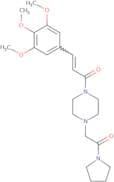
CAS 88197-48-2
:2-Propen-1-one, 1-[4-[2-oxo-2-(1-pyrrolidinyl)ethyl]-1-piperazinyl]-3-(3,4,5-trimethoxyphenyl)-, (2E)-
Description:
The chemical substance known as "2-Propen-1-one, 1-[4-[2-oxo-2-(1-pyrrolidinyl)ethyl]-1-piperazinyl]-3-(3,4,5-trimethoxyphenyl)-, (2E)-" with CAS number 88197-48-2 is a synthetic organic compound characterized by its complex structure, which includes a propenone moiety, a piperazine ring, and a pyrrolidine group. This compound features multiple functional groups, including ketones and methoxy substituents, which contribute to its potential reactivity and biological activity. The presence of the trimethoxyphenyl group suggests possible interactions with biological targets, making it of interest in medicinal chemistry. Its structural features may impart specific pharmacological properties, potentially influencing its solubility, stability, and interaction with biological systems. As with many synthetic compounds, understanding its characteristics requires consideration of its physical properties, such as melting point, solubility, and spectral data, which are essential for applications in research and development. Overall, this compound exemplifies the complexity often found in drug design and development, highlighting the interplay between structure and function in chemical substances.
Formula:C22H31N3O5
InChI:InChI=1S/C22H31N3O5/c1-28-18-14-17(15-19(29-2)22(18)30-3)6-7-20(26)25-12-10-23(11-13-25)16-21(27)24-8-4-5-9-24/h6-7,14-15H,4-5,8-13,16H2,1-3H3/b7-6+
InChI key:InChIKey=RCUDFXMNPQNBDU-VOTSOKGWSA-N
SMILES:O(C)C1=C(OC)C(OC)=CC(/C=C/C(=O)N2CCN(CC(=O)N3CCCC3)CC2)=C1
Synonyms:- 2-Propen-1-one, 1-[4-[2-oxo-2-(1-pyrrolidinyl)ethyl]-1-piperazinyl]-3-(3,4,5-trimethoxyphenyl)-, (2E)-
- Cinepazide
- Piperazine, 1-[2-oxo-2-(1-pyrrolidinyl)ethyl]-4-[1-oxo-3-(3,4,5-trimethoxyphenyl)-2-propenyl]-, (E)-
- (E)-Cinepazide
Sort by
Purity (%)
0
100
|
0
|
50
|
90
|
95
|
100
Found 1 products.
Cinepazime
CAS:<p>Cinepazide is a medicinal analog that has been shown to have potent anticancer properties. It works by inhibiting protein kinases, which are enzymes responsible for regulating cell growth and division. Cinepazide has been tested on human cancer cells and has shown to induce apoptosis, or programmed cell death, in these cells. In Chinese studies, cinepazide has also been found to inhibit the growth of tumors in mice. This inhibitor can be excreted in urine following administration and may have potential as a novel anticancer therapy.</p>Formula:C22H31N3O5Purity:Min. 95%Molecular weight:417.5 g/mol