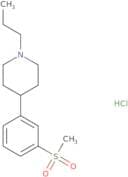
CAS 882737-42-0
:Pridopidine hydrochloride
Description:
Pridopidine hydrochloride is a chemical compound primarily investigated for its potential therapeutic effects in neurodegenerative disorders, particularly Huntington's disease. It acts as a modulator of the sigma-1 receptor, which is implicated in various neuroprotective pathways. The substance is characterized by its ability to enhance neuronal survival and function, potentially alleviating symptoms associated with neurodegeneration. Pridopidine hydrochloride is typically presented as a white to off-white crystalline powder, soluble in water and various organic solvents, which facilitates its formulation for pharmaceutical applications. Its molecular structure includes a piperidine ring, contributing to its pharmacological properties. The compound has undergone various clinical trials to assess its efficacy and safety profile, with a focus on improving motor function and cognitive performance in affected individuals. As with any investigational drug, its use is subject to regulatory approval and ongoing research to fully understand its mechanisms and therapeutic potential.
Formula:C15H23NO2S·ClH
InChI:InChI=1S/C15H23NO2S.ClH/c1-3-9-16-10-7-13(8-11-16)14-5-4-6-15(12-14)19(2,17)18;/h4-6,12-13H,3,7-11H2,1-2H3;1H
InChI key:InChIKey=YGRHOYQMBLLGEV-UHFFFAOYSA-N
SMILES:S(C)(=O)(=O)C=1C=C(C=CC1)C2CCN(CCC)CC2.Cl
Synonyms:- Piperidine, 4-[3-(methylsulfonyl)phenyl]-1-propyl-, hydrochloride (1:1)
- Piperidine, 4-[3-(methylsulfonyl)phenyl]-1-propyl-, hydrochloride
- ACR 16 hydrochloride
- Pridopidine hydrochloride
- FR 310826 hydrochloride
Sort by
Purity (%)
0
100
|
0
|
50
|
90
|
95
|
100
Found 1 products.
4-(3-(Methylsulfonyl)phenyl)-1-propylpiperidine
CAS:4-(3-(Methylsulfonyl)phenyl)-1-propylpiperidine is an analog that has shown promising results as an anticancer agent. It works by inhibiting protein kinases, which are enzymes involved in the growth and spread of tumors. This compound has been found to be effective against a variety of cancer cells, including those from human urine and Chinese medicinal plants. It induces apoptosis, or programmed cell death, in cancer cells by blocking the activity of specific kinases. This inhibitor shows great potential for the development of new cancer treatments.
Formula:C15H24ClNO2SPurity:Min. 95%Molecular weight:317.9 g/mol