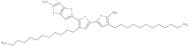
![Poly[thieno[3,2-b]thiophene-2,5-diyl(4,4′-didodecyl[2,2′-bithiophene]-5,5′-diyl)]](/_next/image/?url=https%3A%2Fstatic.cymitquimica.com%2Fcas-image%2Fthumb-webp%2F390340-poly-thieno-32-b-thiophene-25-diyl-44-didodecyl-22-bithiophene-55-diyl.webp&w=3840&q=75)
CAS 888491-18-7
:Poly[thieno[3,2-b]thiophene-2,5-diyl(4,4′-didodecyl[2,2′-bithiophene]-5,5′-diyl)]
Description:
Poly[thieno[3,2-b]thiophene-2,5-diyl(4,4′-didodecyl[2,2′-bithiophene]-5,5′-diyl)], commonly referred to by its CAS number 888491-18-7, is a conjugated polymer known for its application in organic electronics, particularly in organic photovoltaics and field-effect transistors. This polymer exhibits a high degree of planarity and extended π-conjugation, which contributes to its excellent electrical conductivity and charge transport properties. The presence of long alkyl side chains, such as didodecyl groups, enhances its solubility in organic solvents, facilitating processing techniques like spin-coating or inkjet printing. Additionally, the polymer's structural features allow for tunable optical properties, making it suitable for light-harvesting applications. Its thermal stability and mechanical flexibility are also notable, which are essential for the durability of electronic devices. Overall, this polymer represents a significant advancement in the field of organic semiconductors, combining desirable electronic properties with practical processing capabilities.
Formula:(C38H54S4)n
SMILES:C(CCCCCCCCCCC)C1=C(SC(=C1)C2=CC(CCCCCCCCCCCC)=C(*)S2)C3=CC4=C(S3)C=C(*)S4
Synonyms:- Lt-S981
- Pb 12Ttt
- Pbttt-C12
- Poly[thieno[3,2-b]thiophene-2,5-diyl(4,4′-didodecyl[2,2′-bithiophene]-5,5′-diyl)]
- Poly[2,5-bis(3-dodecylthiophen-2-yl)thieno[3,2-b]thiophene]
Sort by
Purity (%)
0
100
|
0
|
50
|
90
|
95
|
100
Found 2 products.
Poly[2,5-bis(3-dodecylthiophen-2-yl)thieno[3,2-b]thiophene]
CAS:Controlled ProductFormula:C38H56S4nColor and Shape:NeatMolecular weight:n(641.11)PBTTT-c12
CAS:PBTTT-c12 is a dodecyl unipolar semiconductor that can be used as a material for electronic devices. PBTTT-c12 has low molecular weight, high solubility, and transport properties. This material crystallizes at room temperature and exhibits a hexagonal crystal structure with a lattice constant of 1.8 Å. It is also soluble in organic solvents such as chloroform or acetone. The optical absorption spectrum shows two bands in the visible region: one near 400 nm, which corresponds to the π* orbital; and another at 600 nm, which corresponds to the π* orbital and the σ* orbital. In addition, PBTTT-c12 semiconductors have been shown to exhibit diffraction patterns at low temperatures (below -200°C).
Formula:(C38H54S4)nPurity:Min. 95%Ref: 3D-NKB49118
Discontinued product
![Poly[2,5-bis(3-dodecylthiophen-2-yl)thieno[3,2-b]thiophene]](/_next/image/?url=https%3A%2Fstatic.cymitquimica.com%2Fproducts%2FTR%2Fthumb%2FP688050.jpg&w=3840&q=75)