CAS 88937-61-5
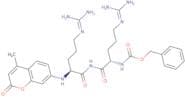
:Z-Arg-Arg-AMC
- Z-Arg-Arg-AMC
- Benzyloxycarbonyl-L-arginyl-L-arginine 4-methylcoumaryl-7-amide
- 386: PN: US20220178935 SEQID: 1064 claimed sequence
- N2-[(Phenylmethoxy)carbonyl]-L-arginyl-N-(4-methyl-2-oxo-2H-1-benzopyran-7-yl)-L-argininamide
- L-Argininamide, N2-[(phenylmethoxy)carbonyl]-L-arginyl-N-(4-methyl-2-oxo-2H-1-benzopyran-7-yl)-
- Z-Arg-Arg-NHMec
- Z-ARG-ARG-MCA(HYDROCHLORIDE FORM)
- Z-ARG-ARG-MCA HYDROCHLORIDE
- BENZYLOXYCARBONYL-L-ARGINYL-L-ARGININE 4-METHYLCOUMARYL-7-AMIDE HYDROCHLORIDE
- benzyl N-[(2S)-5-(diaminomethylideneamino)-1-[[(2S)-5-(diaminomethylideneamino)-2-[(4-methyl-2-oxochromen-7-yl)amino]pentanoyl]amino]-1-oxopentan-2-yl]carbamate
- N-ALPHA-CBZ-ARG-ARG 7-AMIDO-4-METHYLCOUMARIN HYDROCHLORIDE
- Z-ARG-ARG-AMC HYDROCHLORIDE SALT
- benzyloxycarbonylarginyl-arginine 4-methylcoumarin-7-ylamide
- See more synonyms
Z-Arg-Arg-AMC
CAS:Z-RR-AMC, an excellent, specific substrate for cathepsin B, an enzyme found in secretory vesicles. Cathepsin B has been identified as a β-secretase, as such it is involved in β-amyloid production. Z-RR-AMC is a convenient fluorogenic substrate for stem bromelain, as it is scarcely affected by fruit bromelain.Formula:C30H39N9O6Purity:> 98%Color and Shape:White PowderMolecular weight:621.7Z-Arg-Arg-AMC hydrochloride salt
CAS:Z-Arg-Arg-AMC hydrochloride salt is a versatile compound that acts as a catalyst and forms strong hydrogen bonds. It exhibits proteolytic activity and has been found to be effective in breaking down proteins. In addition, Z-Arg-Arg-AMC hydrochloride salt has been shown to possess neuroprotective properties, making it a potential candidate for the treatment of neurological disorders. It also demonstrates anthelmintic activity, which means it can be used to combat parasitic worm infections. Furthermore, this compound has antioxidant activity and can help reduce lipid peroxidation, protecting cells from oxidative damage. With its diverse range of characteristics, Z-Arg-Arg-AMC hydrochloride salt holds great promise in various research fields such as biochemistry and medicine.
Formula:C30H39N9O6·xHClPurity:Min. 95%Color and Shape:PowderMolecular weight:621.69 g/molRef: 3D-FA110491
Discontinued productZ-Arg-Arg-AMC
CAS:Z-Arg-Arg-AMC is an activator of the receptor tyrosine kinase (RTK) system. It binds to the extracellular domain of RTKs, such as epidermal growth factor receptors (EGFR) and fibroblast growth factor receptors (FGFR), and activates these receptors. This compound has been shown to activate EGFR and FGFR at low concentrations and inhibit their activation at high concentrations. Z-Arg-Arg-AMC has also been shown to be a potent inhibitor of protein interactions with a Kd of approximately 1 μM, which makes it a useful research tool for studying protein interactions.
Formula:C30H39N9O6Purity:Min. 95%Molecular weight:621.69 g/mol