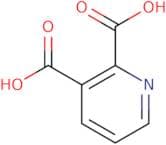
CAS 89-00-9
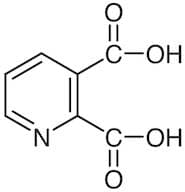
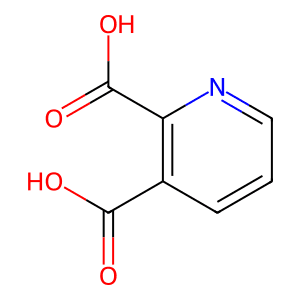
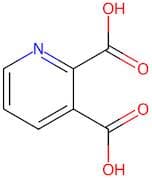
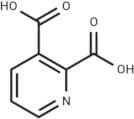
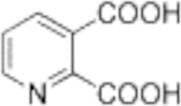
:Quinolinic acid
Description:
Quinolinic acid is an aromatic heterocyclic compound with the molecular formula C9H7NO2. It is a derivative of quinoline and is characterized by a carboxylic acid functional group attached to the quinoline ring. This compound is typically a white to pale yellow crystalline solid that is soluble in water and organic solvents. Quinolinic acid is known for its role as a metabolite in the kynurenine pathway, which is involved in the metabolism of the amino acid tryptophan. It has garnered interest in neurobiology due to its potential neurotoxic effects and involvement in various neurological disorders. Additionally, quinolinic acid exhibits properties as a ligand for certain receptors, influencing neurotransmission. Its synthesis can be achieved through various methods, including the oxidation of quinoline derivatives. Due to its biological significance, quinolinic acid is studied for its implications in conditions such as schizophrenia, depression, and neurodegenerative diseases. Safety precautions should be observed when handling this compound, as it may pose health risks in certain concentrations.
Formula:C7H5NO4
InChI:InChI=1S/C7H5NO4/c9-6(10)4-2-1-3-8-5(4)7(11)12/h1-3H,(H,9,10)(H,11,12)
InChI key:InChIKey=GJAWHXHKYYXBSV-UHFFFAOYSA-N
SMILES:C(O)(=O)C1=C(C(O)=O)N=CC=C1
Synonyms:- 2,3-Pyridine Dicarboxylic Acid
- Acide pyridine-2,3-dicarboxylique
- Acido Piridina-2,3-Dicarboxilico
- Akos Auf2085
- Akos Bbs-00003814
- Nsc 13127
- Nsc 18836
- Nsc 403247
- Pyridin-2,3-dicarbonsaure
- Pyridine-2,3-dicarboxylate
- Pyridine-2,3-dicarboxylic acid
- Quinolic Acid
- Quinolinic Acid
- Rarechem Al Bo 0810
- See more synonyms
Sort by
Purity (%)
0
100
|
0
|
50
|
90
|
95
|
100
Found 13 products.
2,3-Pyridinedicarboxylic Acid
CAS:Formula:C7H5NO4Purity:>98.0%(GC)(T)Color and Shape:White to Light yellow to Light orange powder to crystalMolecular weight:167.12Pyridine-2,3-dicarboxylic acid, 99%
CAS:Quinolinic acid is an endogenous NMDA agonist. Quinolinic acid is a metabolite of tryptophan that acts as a putative NMDA receptor agonist. Quinolinic acid is an excitotoxic metabolite and an agonist of N-methyl-D-aspartate receptors. properties of KYNA raise the possibility of a functional link beFormula:C7H5NO4Purity:99%Color and Shape:White to yellow to pale cream, PowderMolecular weight:167.122,3-Pyridinedicarboxylic acid
CAS:2,3-Pyridinedicarboxylic acidPurity:99%Molecular weight:167.12g/molQuinolinic acid
CAS:Quinolinic acid (QUIN) is an endogenous N-methyl-D-aspartate (NMDA) receptor agonist synthesized from L-tryptophan via the kynurenine pathway.Formula:C7H5NO4Purity:99.27% - 99.98%Color and Shape:Crystals DrypowderMolecular weight:167.122,3-Pyridinedicarboxylic Acid-13C3, 15N
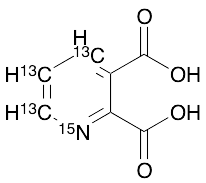
CAS:Applications 2,3-Pyridinedicarboxylic Acid-13C3, 15N, is the labeled analogue of 2,3-Pyridinedicarboxylic Acid (P991630), An inhibitor of glucose synthesis.
References Martirosyan, A., et al.: Biochem. Pharmacol., 68, 1729 (2004),Formula:C413C3H515NO4Color and Shape:NeatMolecular weight:171.092,3-Pyridinedicarboxylic Acid
CAS:Controlled ProductApplications An inhibitor of glucose synthesis.
References Martirosyan, A., et al.: Biochem. Pharmacol., 68, 1729 (2004),Formula:C7H5NO4Color and Shape:Off White SolidMolecular weight:167.122,3-Pyridinedicarboxylic acid
CAS:2,3-Pyridinedicarboxylic acid is a metabolite of glutamate and quinolinate. It has been shown to inhibit mitochondrial membrane potential, which may lead to neuronal death. 2,3-Pyridinedicarboxylic acid is also an inhibitor of the enzyme activities of the group P2 synthetases. The compound can act as a pharmacological agent against infectious diseases such as malaria and tuberculosis.Formula:C7H5NO4Purity:Min. 98 Area-%Color and Shape:White PowderMolecular weight:167.12 g/mol2,3-Pyridine dicarboxylic acid
CAS:Formula:C7H5NO4Purity:98%Color and Shape:Solid, Light yellow powderMolecular weight:167.12