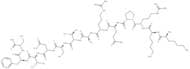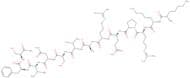
CAS 89315-28-6
:(2S)-N-[(1S)-1-[[(1S)-2-[[(1S,2R)-1-[[(1S)-2-[[(1S)-3-amino-1-[[(1S)-1-[[(1S)-2-[[(1S)-2-amino-1-(hydroxymethyl)-2-oxo-ethyl]amino]-1-benzyl-2-oxo-ethyl]carbamoyl]-2-methyl-propyl]carbamoyl]-3-oxo-propyl]amino]-1-(hydroxymethyl)-2-oxo-ethyl]carbamoyl]-2-h
Description:
The chemical substance with the name "(2S)-N-[(1S)-1-[[[1S)-2-[[(1S,2R)-1-[[[1S)-2-[[(1S)-3-amino-1-[[(1S)-1-[[(1S)-2-[[(1S)-2-amino-1-(hydroxymethyl)-2-oxo-ethyl]amino]-1-benzyl-2-oxo-ethyl]carbamoyl]-2-methyl-propyl]carbamoyl]-3-oxo-propyl]amino]-1-(hydroxymethyl)-2-oxo-ethyl]carbamoyl]-2-h" and CAS number "89315-28-6" is a complex organic compound characterized by its intricate structure, which includes multiple chiral centers and functional groups such as amino, hydroxymethyl, and carbamoyl moieties. This compound likely exhibits properties typical of peptides or peptide-like substances, including potential biological activity, solubility in polar solvents, and the ability to form hydrogen bonds due to its numerous functional groups. Its stereochemistry suggests that it may interact specifically with biological targets, making it of interest in pharmaceutical research. The presence of multiple functional groups indicates potential for diverse reactivity and interactions, which could be explored in various chemical and biological contexts.
Formula:C65H112N24O18
InChI:InChI=1/C65H112N24O18/c1-33(2)49(61(105)84-42(29-36-15-6-5-7-16-36)57(101)85-44(31-90)51(71)95)87-58(102)43(30-48(70)94)83-59(103)45(32-91)86-62(106)50(35(4)92)88-52(96)34(3)78-54(98)39(19-12-26-76-64(72)73)80-56(100)40(22-23-47(69)93)81-60(104)46-21-14-28-89(46)63(107)41(20-13-27-77-65(74)75)82-55(99)38(18-9-11-25-67)79-53(97)37(68)17-8-10-24-66/h5-7,15-16,33-35,37-46,49-50,90-92H,8-14,17-32,66-68H2,1-4H3,(H2,69,93)(H2,70,94)(H2,71,95)(H,78,98)(H,79,97)(H,80,100)(H,81,104)(H,82,99)(H,83,103)(H,84,105)(H,85,101)(H,86,106)(H,87,102)(H,88,96)(H4,72,73,76)(H4,74,75,77)/t34-,35+,37-,38-,39-,40-,41-,42-,43-,44-,45-,46-,49-,50-/m0/s1
Synonyms:- LEU-ARG-ARG-ALA-SER-LEU-GLY-NH2: LRRASLG-NH2
- K-MLC (11-23) AMIDE
- K-MYOSIN LIGHT CHAIN (11-23) AMIDE
- KEMPTIDE, AMIDE
- K-Myosin Light Chain (11-23) aMide, K-MLC (11-23) aMide
- H-LEU-ARG-ARG-ALA-SER-LEU-GLY-NH2
- H-LYS-LYS-ARG-PRO-GLN-ARG-ALA-THR-SER-ASN-VAL-PHE-SER-NH2
- KEMTAMIDE
- KEMPTAMIDE
- LYS-LYS-ARG-PRO-GLN-ARG-ALA-THR-SER-ASN-VAL-PHE-SER-NH2
- KKRPQRATSNVFS-NH2
- LEU-ARG-ARG-ALA-SER-LEU-GLY-NH2
- See more synonyms
Sort by
Purity (%)
0
100
|
0
|
50
|
90
|
95
|
100
Found 2 products.
Kemptamide
CAS:Kemptamide is a synthetic peptide with 13-residue.Formula:C65H112N24O18Purity:98%Color and Shape:SolidMolecular weight:1517.73Kemptamide trifluoroacetate salt
CAS:Kemptamide is a peptide that has been shown to have cytotoxic and anti-proliferative effects on renal cancer cells. It is a synthetic analogue of an endogenous peptide, Lys-Lys-Arg-Pro-Gln-Arg-Ala-Thr-Ser-Asn-Val-Phe, that is found in porcine kidney. Kemptamide’s cytotoxic activity may be due to its ability to inhibit the activity of phosphatases. Kemptamide also has regulatory properties and can modulate the expression of genes that are involved in cell growth and apoptosis. This peptide has been shown to be reactive with kidney cells, which may lead to its therapeutic effect on renal cancer.
Formula:C65H112N24O18Purity:Min. 95%Molecular weight:1,517.74 g/mol