CAS 89364-04-5
:Pyridine, 3-bromo-4-nitro-
Description:
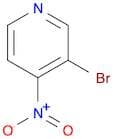
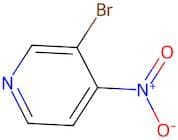
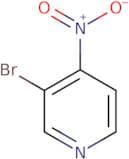
Pyridine, 3-bromo-4-nitro- is an organic compound characterized by a pyridine ring substituted with both a bromine atom and a nitro group. The presence of these substituents significantly influences its chemical properties and reactivity. The bromine atom, being a good leaving group, can participate in nucleophilic substitution reactions, while the nitro group is an electron-withdrawing group that can enhance the acidity of nearby hydrogen atoms and influence electrophilic aromatic substitution reactions. This compound is typically a yellow to brown solid at room temperature and is soluble in polar organic solvents. Its applications may include use in organic synthesis, as an intermediate in the production of pharmaceuticals, agrochemicals, or other fine chemicals. Safety considerations are important, as nitro compounds can be hazardous, and appropriate handling and disposal measures should be observed. Overall, 3-bromo-4-nitropyridine serves as a valuable building block in various chemical syntheses due to its unique reactivity profile.
Formula:C5H3BrN2O2
InChI:InChI=1/C5H3BrN2O2/c6-4-3-7-2-1-5(4)8(9)10/h1-3H
SMILES:c1cncc(c1N(=O)=O)Br
Synonyms:- 3-Bromo-4-nitropyridine
Sort by
Purity (%)
0
100
|
0
|
50
|
90
|
95
|
100
Found 4 products.
3-Bromo-4-nitropyridine
CAS:Formula:C5H3BrN2O2Purity:95%Color and Shape:SolidMolecular weight:202.99353-Bromo-4-nitropyridine
CAS:3-Bromo-4-nitropyridinePurity:97%Color and Shape:SolidMolecular weight:202.99g/mol3-Bromo-4-nitropyridine
CAS:Formula:C5H3BrN2O2Purity:98.0%Color and Shape:Solid, Crystalline Powder or PowderMolecular weight:202.9953-Bromo-4-nitropyridine
CAS:3-Bromo-4-nitropyridine is a pyridine compound that has been identified as an environmental contaminant. It is used to synthesize other compounds, such as 4-(3-bromopyridin-2-yl)morpholine, which is used in the synthesis of acetonitrile. 3-Bromo-4-nitropyridine undergoes nucleophilic substitution reactions with amines, leading to homoconjugation and bond cleavage. This reaction may be followed by nitration to give 3-(3'-nitro)pyridine. 3-Bromo-4-nitropyridine can be converted into its n-oxide form or into the ionic form by treatment with acetonitrile.Formula:C5H3BrN2O2Purity:Min. 95%Color and Shape:Yellow PowderMolecular weight:202.99 g/mol